
Clayton, NC · Water Damage
Hardwood Floor Water Damage Repair, Clayton NC
For hardwood floor water damage repair, Clayton NC homeowners get the same order from us every time: find and stop the moisture, read the wood and subfloor with meters, wait for dry readings, then repair. $1,500 minimum.
Hardwood Floor Water Damage Repair, Clayton NC: The Short Answer
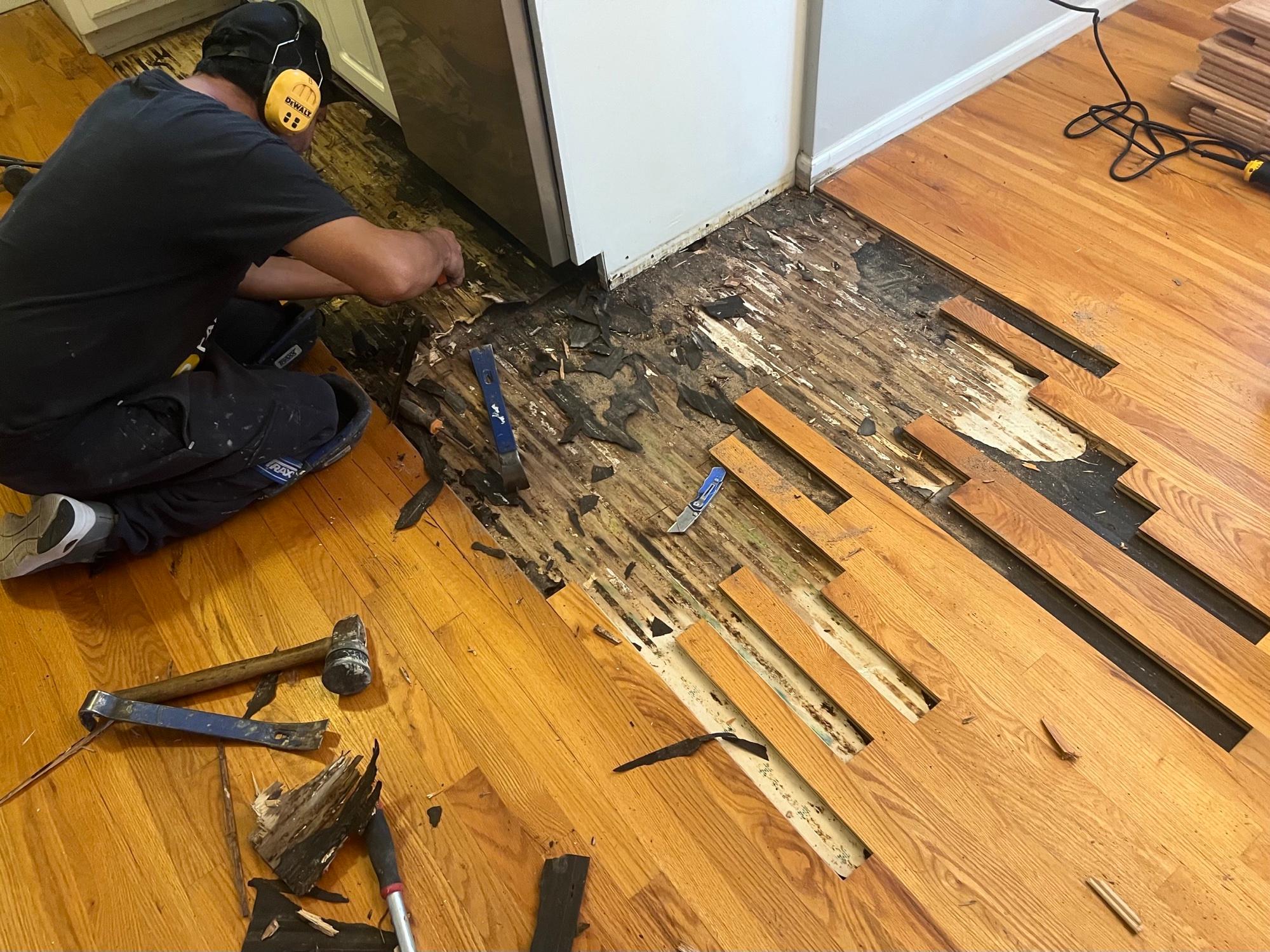
Most water-damaged hardwood can be repaired, not replaced, once the leak is fixed and the floor is dry. We cut out the boards that stained black, buckled, or rotted, weave matching boards into the existing rows, and sand and finish the connected floor so the repair disappears. Repairs carry a $1,500 minimum.
We do not extract water, run drying equipment, or offer emergency service. When there is standing water, a water mitigation company dries the structure first, and we repair the floor after. If you are hiring one, ask whether their technicians work to the IICRC S500 standard for water damage restoration.
Still in the first day or two after a leak? Our checklist for a water leak under hardwood floors covers what to do before anyone takes a reading. For every other kind of repair, see our hardwood floor repair in Clayton page.
- Minimum
$1,500
Repair work, with or without sanding and finishing.
- Drying time
Set by readings
Days for a small area, longer for a big soak or damp crawl space.
- Matching
Whole connected floor
New and existing boards sanded and finished together.
- Sand and finish
4 to 6 days
After the new boards are in and have settled.
The Order of Work, From Leak to Finished Floor
Every water damage repair runs in this order, and skipping a step is how floors fail twice. The one we never skip is waiting for dry readings: sand a wet, cupped floor flat and every board crowns once it dries.
01
Stop the source
Your plumber fixes the leak: dishwasher, ice maker line, toilet, water heater, or a pipe in the crawl space. Nothing else holds until the water stops.
02
Dry the structure
With standing water or a large soak, a water mitigation company dries the structure first. For a contained leak, we pull the wet boards early so the subfloor can breathe.
03
Read the moisture
We read the hardwood and the subfloor with a Tramex MEX5 pinless meter and a Delmhorst Total Check pin meter, and compare them to known dry areas of the house.
04
Wait for dry readings
New wood goes down only when the readings line up. Drying takes days on a small area and longer on a big soak or a damp crawl space.
05
Settle, lace in, or refinish
Cupped boards that relax flat may need nothing. Stained, buckled, or rotted boards are cut out and laced in. Then the connected floor is sanded and finished together.
Who Does What After a Leak in a Clayton Home
Three trades, in sequence. We are the last one: the floor gets repaired after the source is fixed and the structure is dry.
Your plumber
Finds and fixes the leak. When a dishwasher, refrigerator, washer, or toilet has to come out so we can reach the floor under it, your plumber disconnects it before we start and reconnects it when the floor is done.
A water mitigation company
Needed for standing water, a large soak, or dirty water from a drain line or toilet. They extract water and dry the structure with their equipment. The EPA's guide to mold and moisture in your home says wet materials dried within 24 to 48 hours usually do not grow mold, which is why that call should come first.
12th And Oak
Reads the moisture in the wood and subfloor, removes the damaged boards, repairs the floor once readings are dry, and matches it to the rest of the house. The proposal is written to you, and you can share it with your insurer.
Clayton Floors and Water
Technical Considerations for Water Damaged Hardwood in Clayton, NC
Water Damage: Cosmetic or Structural?
It is cosmetic when only the finish and the top of the wood took the water, and structural when the boards or the subfloor are stained through, delaminated, soft, or rotted. Light gray staining in the finish and minor cupping that relaxes as the floor dries are usually cosmetic: the floor gets sanded and refinished once it reads dry. Black staining means water sat in the wood long enough to react with it, and those boards come out.
Structural damage goes deeper. A slow dishwasher leak in a Clayton kitchen can soak the plywood under the hardwood for months before anyone sees it, and soft or rotted subfloor gets cut out and rebuilt before any new hardwood goes down. Mold, or water from a drain line or toilet, changes the job: soaked subfloor is removed rather than dried, and a mitigation company may need to clean up first.
Crawl Space and Slab Homes Get Wet Differently
In older Clayton homes around downtown, built on crawl space foundations, water usually reaches the floor from below. A leaking pipe under the house or a crawl space with a failed vapor barrier soaks the subfloor from underneath, and the first sign is cupping: board edges higher than the centers. These homes also give us access from below, so we check the crawl space as well as reading the floor from the top. Our guide to why hardwood floors cup in NC covers moisture from below in detail.
Newer Clayton construction, including much of Flowers Plantation, Portofino, Tuscany, and Walden, sits on slab-on-grade foundations. On a slab, water from an appliance or a supply line runs across the concrete under the flooring and has nowhere to drain or dry out from below, so it spreads farther than the stain on top shows. We map where the wet area actually ends with readings before deciding what comes out.
How Long Does a Water-Damaged Floor Take to Dry?
As long as the readings say, and no fixed number of days. A small area with good airflow can be ready in days; a big soak, a leak that ran for weeks, or a crawl space that stays damp through a Johnston County summer takes longer. Taking the wet boards out starts the drying, because soaked hardwood holds water against the subfloor. It is not the drying itself.
We compare the subfloor and the hardwood to each other and to known dry areas of the house. Readings above roughly 12 percent moisture content, or a big spread between the top and bottom of the floor, mean it is still wet. The same readings decide when cupped boards that might settle on their own get re-measured, often six weeks later, before anyone sands.
Can the Repaired Boards Be Matched?
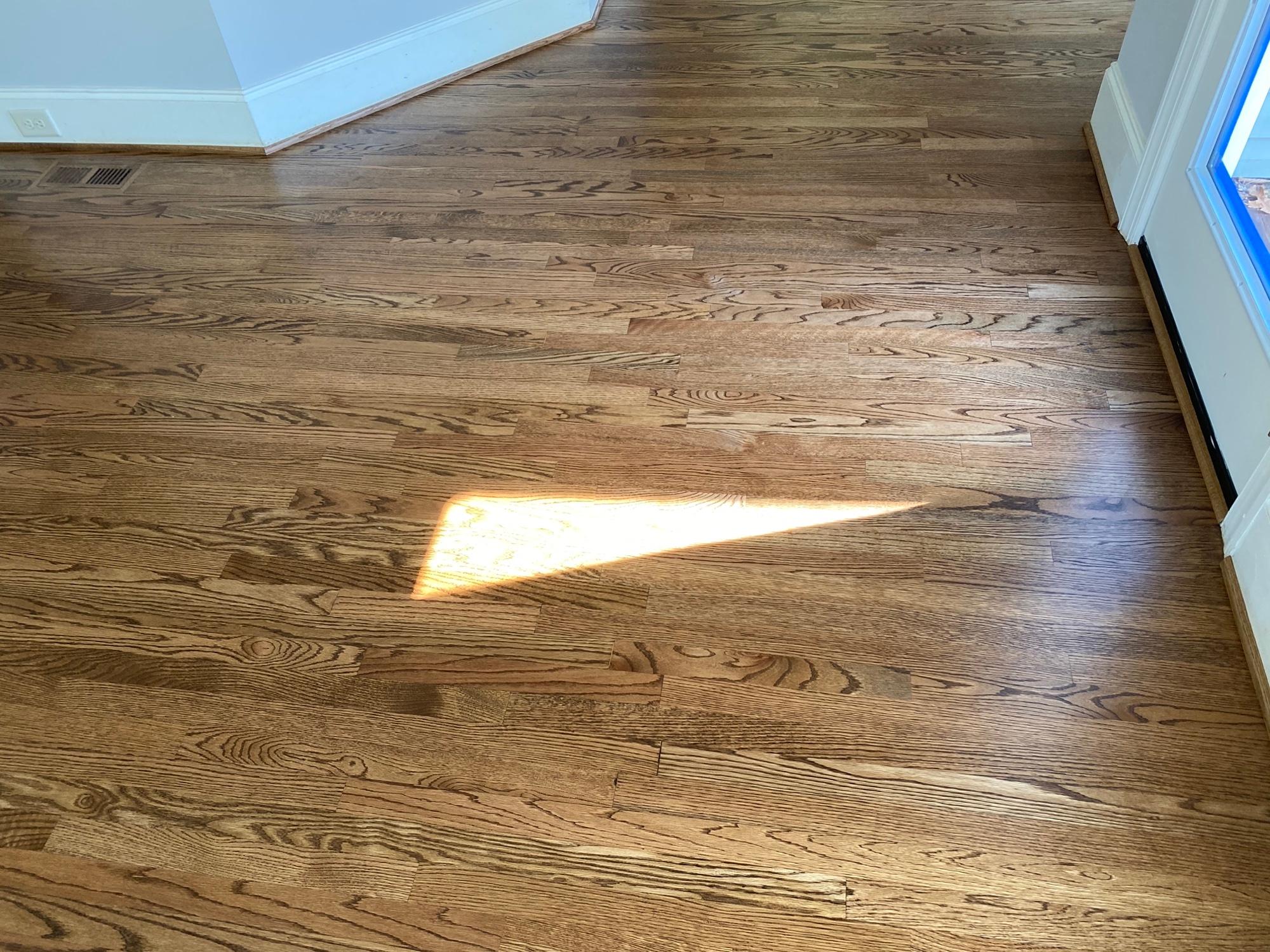
Yes, when the whole connected floor is sanded and finished with the new boards. The new boards have to be the exact width of the old ones so they weave into the existing rows; we measure a board before ordering anything. That weave is a lace-in, and it keeps a straight seam from showing.
Color is the harder part. Glen Laurel and Riverwood homes from the 1990s and 2000s mostly have 2.25-inch or 3-inch red oak, which is widely available, but the existing floor has aged under light and new wood has not. Replacing boards alone leaves a visible color difference; sanding new and old together brings them back to the same starting point. Our post on whether a water-damaged patch can match lays out the three options and what each looks like finished. Original heart pine in downtown Clayton homes is harder to match, and we tell you how close we can get before work starts.
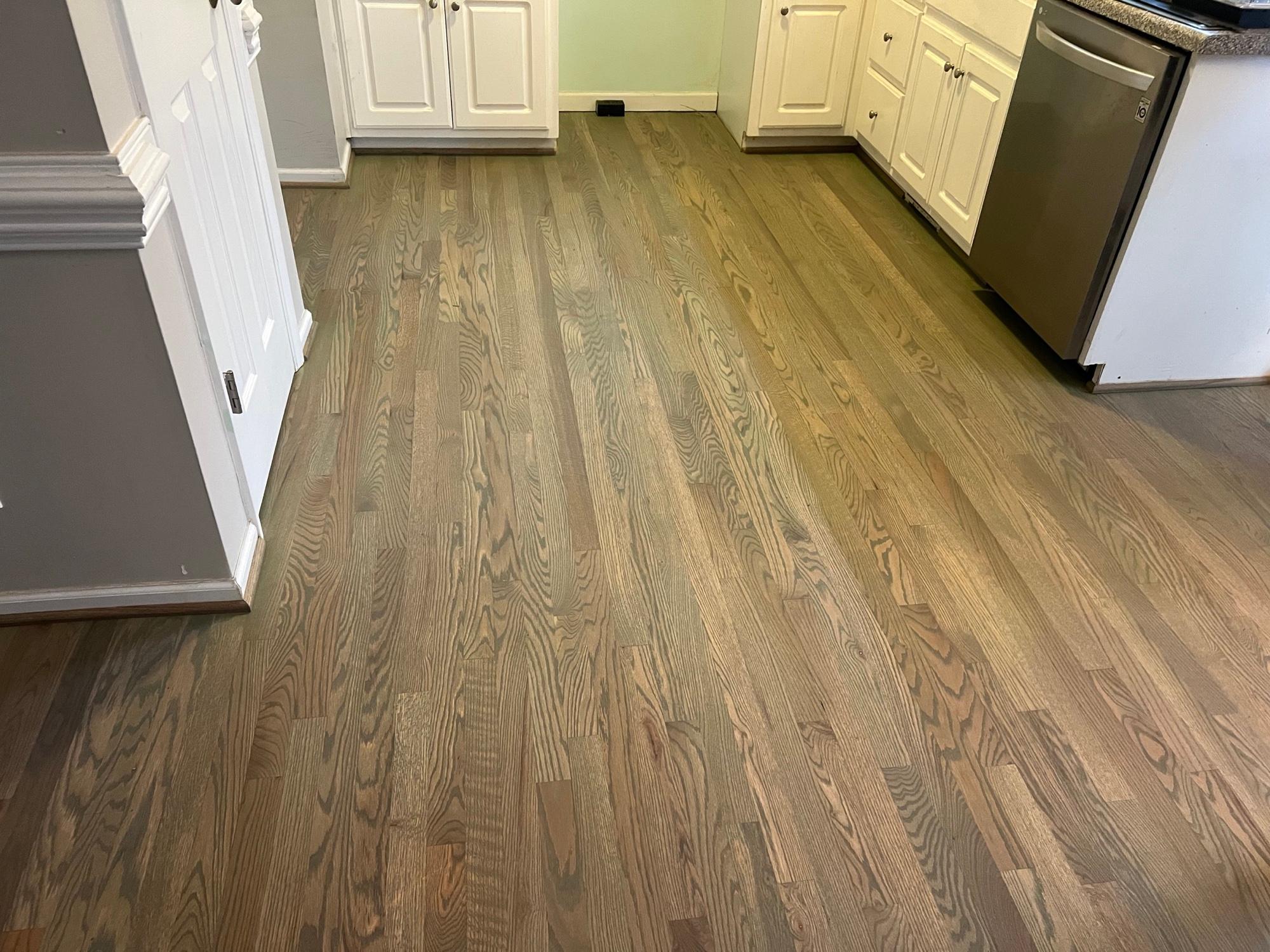
A Clayton Dishwasher Leak, Before and After
In a Matthews Farm kitchen, a dishwasher leak had rotted the hardwood and the plywood under it. We cut out the damaged boards and subfloor, rebuilt the section, laced in new red oak with glue and nails, then sanded the whole kitchen floor and finished it with a custom hardwax oil blend.
What Hardwood Floor Water Damage Repair in Clayton NC Costs
Repair work carries a $1,500 minimum, with or without sanding and finishing. Above the minimum, the board replacement, any subfloor repair, and demolition are priced from what we find on site, and refinishing the connected floor runs $5.50 to $8.00 per square foot.
The free preliminary estimate comes from your photos and measurements of the damaged area. Water damage almost always needs moisture readings in person, so most of these projects need an in-home assessment: a $100 fee, confirmed before the visit, which may be credited toward your project deposit. Exact prices come in the written proposal.
When water reached most of the floor, or the boards are too thin to sand again, replacing the floor can be the cleaner answer. Our hardwood floor repair page covers the full range of repairs we do across Johnston County and the Triangle.
After the Leak
Water Damage Repair Questions From Clayton Homeowners
Repair work carries a $1,500 minimum, with or without sanding and finishing. Above the minimum, the price comes from what we find: how many boards come out, any subfloor repair, and whether the connected floor gets sanded and refinished so the new boards match. Refinishing existing hardwood runs $5.50 to $8.00 per square foot. Your written proposal confirms the price for your floor.
It depends on the moisture readings, not the calendar. A small area with good airflow can be ready in days. A larger soak, a slow leak that ran for weeks, or a damp crawl space takes longer. On a Clayton dishwasher leak, the wet boards came out on the first visit and the new boards went in eleven days later, once the readings were dry. Nothing new goes down until the subfloor and the surrounding hardwood read dry.
No. We are a flooring contractor, not a water mitigation company. If there is standing water or a large soak, a mitigation company with drying equipment dries the structure first. Your plumber fixes the leak. Once the moisture readings say the floor and subfloor are dry, we repair the hardwood.
Often, yes, if the leak was fixed quickly. Boards that cupped from one leak or one humid season usually relax back toward flat as they dry. That takes weeks at minimum, sometimes a full heating season. Cupping that sat for years can take a permanent set, and that floor gets sanded flat once it is dry. A wet, cupped floor is never sanded: the boards crown when they dry.
Yes, when we lace in the new boards and then sand and refinish the whole connected floor together. Replacing boards without refinishing leaves a visible color difference, because the existing floor has aged under light and the new boards have not. Older Clayton homes mostly have red oak, which is widely available; original heart pine in downtown homes is harder, and we tell you how close a match is realistic before any work begins.
No. We write the proposal to you, the homeowner, and you can share it with your insurer along with our moisture readings and your photos from the day of the leak. Whether a repair is covered is up to your insurer and your policy.
Start with the free preliminary estimate: send photos and measurements of the damaged area. Water damage usually needs moisture readings on site, so most of these projects need an in-home assessment. The assessment fee is $100, confirmed before the visit, and it may be credited toward your project deposit.
Ready to Get Started?
Start With aFree Estimate
Serving Clayton, Garner, Raleigh, Cary, and communities throughout Johnston, Wake, and Durham Counties. We respond the same business day.
Want us to come out? Request an in-home assessment →
After you request an estimate, we review your photos and project details and send a free preliminary estimate. When a project needs an in-home assessment, we confirm any assessment fee before scheduling the visit. You will receive a written proposal with the scope, products, timeline, and warranty clearly explained.
Want to see our work first? Browse the portfolio →
Where We Work
Serving the Triangle Since 2002
Based in Clayton, NC. We travel throughout Johnston, Wake, and Durham Counties. Call to confirm your specific location.
Johnston County
Home Base- Clayton
- Garner
- Smithfield
- Selma
- Four Oaks
- Benson
- Kenly
- Princeton
Wake County
- Raleigh
- Garner
- Cary
- Apex
- Fuquay-Varina
- Holly Springs
- Wake Forest
- Knightdale
- Wendell
- Zebulon
Durham and Orange Counties
- Durham
- Chapel Hill
- Hillsborough
Don't see your city? Call us. We consider jobs outside these areas on a case-by-case basis, particularly for larger projects.
984-400-4OAK (4625)Leak Fixed? Send Us Photos of the Floor.
Photos of the damaged area and the room give us enough for a free preliminary estimate. We reply the same business day. Our showroom is in Clayton, and you can see the rest of what we do on our Clayton flooring services page.
113 State Ave #103, Clayton, NC 27520