
Why a Patch Shows: Wood Changes Color Once It Is Down
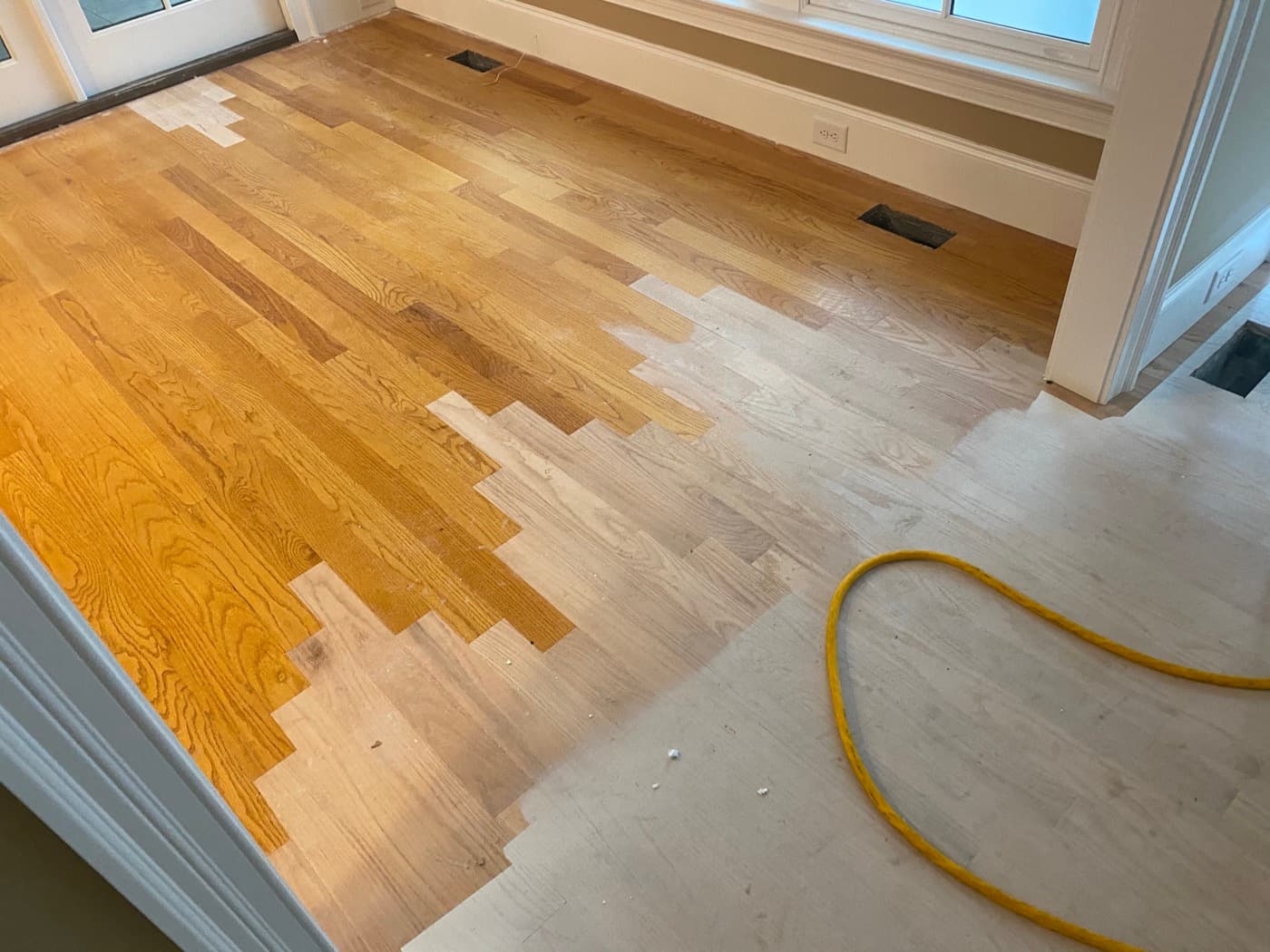
Every hardwood floor changes color after it is installed. Light, especially sun through windows, darkens or ambers the wood and the finish over months and years. The floor you live on today is not the color it was the day it went in. The boards that were left over in the garage, still sealed in their box, have not seen that light at all.
That is why a repair can use the exact same product, from the exact same box, and still look like a patch. Some species make this more obvious than others. American cherry darkens noticeably with light over months, which is normal for the species and one of the reasons people choose it. On a cherry floor, fresh boards next to aged boards are a clear step in color. The floor in this month's job was prefinished American cherry.
First, the Boards Have to Fit: Width Must Match Exactly
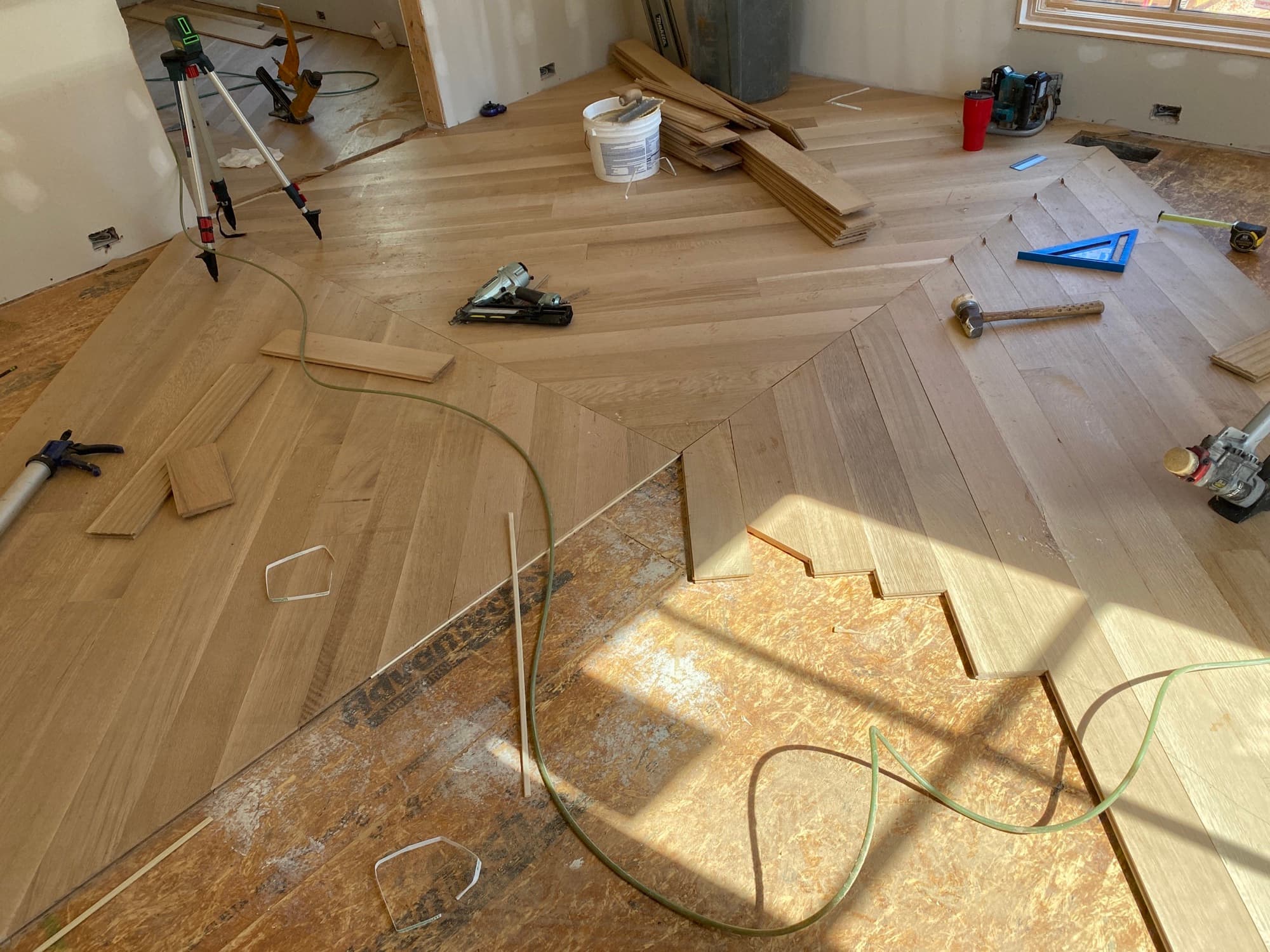
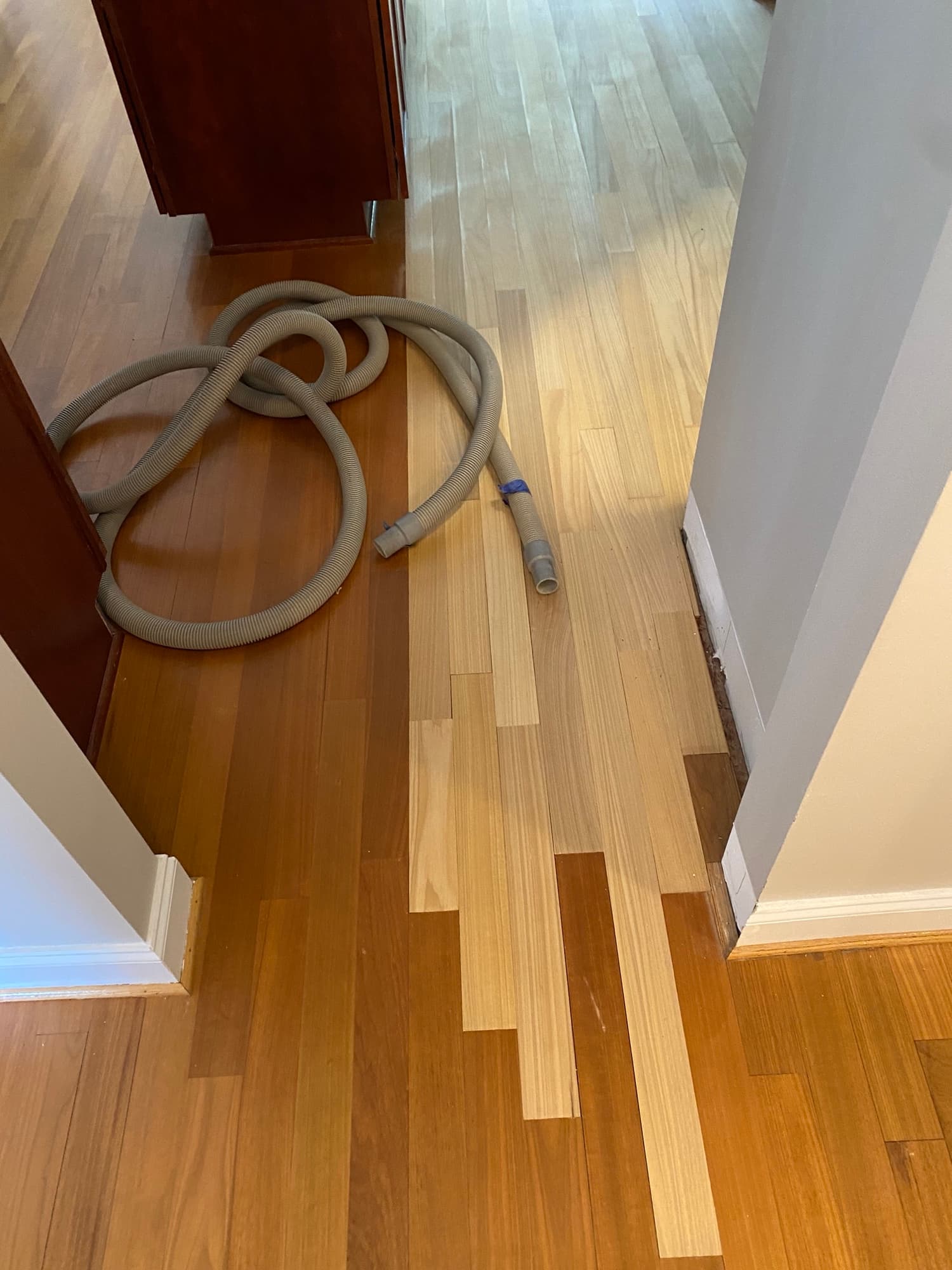
A water damage repair is usually a lace-in: damaged boards are cut out in a staggered pattern and new boards are woven into the existing rows so the end joints interlock. For that to work, the new boards have to be exactly the same width as the old ones. A 3 inch board will not weave into a 3-1/4 inch floor. The rows drift, the joints stop lining up, and the repair shows for reasons that have nothing to do with color. Before we order anything, we measure an existing board.
Before Any Repair: Fix the Leak, Then Check Moisture
Before any repair begins, the leak has to be corrected and the flooring and subfloor checked for moisture. We take moisture readings, comparing the subfloor and the hardwood to each other and to known dry areas of the house, to decide when the floor is ready for repair and refinishing. If you are still in the first days after a leak, our guide to a water leak under hardwood floors covers what to do first.
The Three Options We Offered
The homeowner had a water-damaged area in a prefinished cherry floor and several boxes of the original flooring left over from the install. Here is how we laid out the choices.
Option A: Repair Only, With the Leftover Boxed Flooring
We cut out the damaged area and lace in boards from the homeowner's boxes. Same product, same width, same factory finish, and the least expensive of the three. The trade-off is stated plainly in the proposal: the repaired area will be a different color. The installed floor has changed with age and sun exposure, and the boxed boards have not. On cherry, the difference is easy to see.
This is repair-only work, which carries a $1,000 minimum.
Option B: Repair With New Boards, Then Sand and Refinish the Whole Floor
We lace in replacement boards, then sand and refinish the entire floor as one surface. That includes the existing flooring around the repair, not just the damaged area. Sanding removes the aged surface from the old boards and the factory finish from both, so every board starts the same color on the same day and ages together from then on. This is how we guarantee a 100% match.
Because the existing floor is prefinished, sanding also takes down the factory micro-bevels between boards and has to cut through a hard factory finish, which is more work than a standard sand. When it is done, the floor is a site-finished floor, and the homeowner chooses the stain color and finish system like any refinish. If you are wondering whether your prefinished floor can take that, our post on whether prefinished hardwood can be sanded and refinished covers the wear layer check we do first.
What “the entire floor” means. We normally refinish the entire hardwood floor, not just the room with the damage. A line between a freshly refinished room and one that was not refinished shows the same way a patch does. Your proposal lists exactly which rooms are included.
Option B carries a $1,500 minimum on the whole job, repair and refinishing together. Above that, the refinishing is priced from the floor's square footage at $5.50 to $8.00 per square foot, and the repair from what we find.
Option C: Replace the Whole Floor
If the water reached a large share of the floor, if the existing boards are too thin to sand, or if the homeowner wants a different look anyway, replacing the floor is a clean answer. Everything is new, and nothing has to match anything. Our refinishing vs. replacement guide walks through when that bigger step makes sense. New site-finished hardwood installation runs $15 to $25 per square foot turnkey (material, install, sand, and finish), with a $1,500 minimum. Removing the existing floor, subfloor repairs, furniture moving, and sales tax are separate.
At a Glance
| A: Repair only | B: Repair + refinish | C: Replace | |
|---|---|---|---|
| Scope | Damaged area only | Repair, then the entire floor sanded and refinished as one surface | Whole floor replaced |
| Color match | Repaired area will be a different color | Guaranteed 100% match | All new, one color |
| Seam | Woven in, no straight line | Woven in, sanded flush | None |
| Time | Shortest | Repair, then 4 to 6 days to sand and finish | Longest |
| Pricing | $1,000 minimum | $1,500 minimum on the whole job; refinishing $5.50 to $8.00 per sq ft | $15 to $25 per sq ft turnkey, demo separate |
Which option makes sense for your floor?
Send us photos for a free preliminary estimate, or book an in-home assessment to measure your boards and check moisture. We price the options that fit your floor side by side.
Request a Free Estimate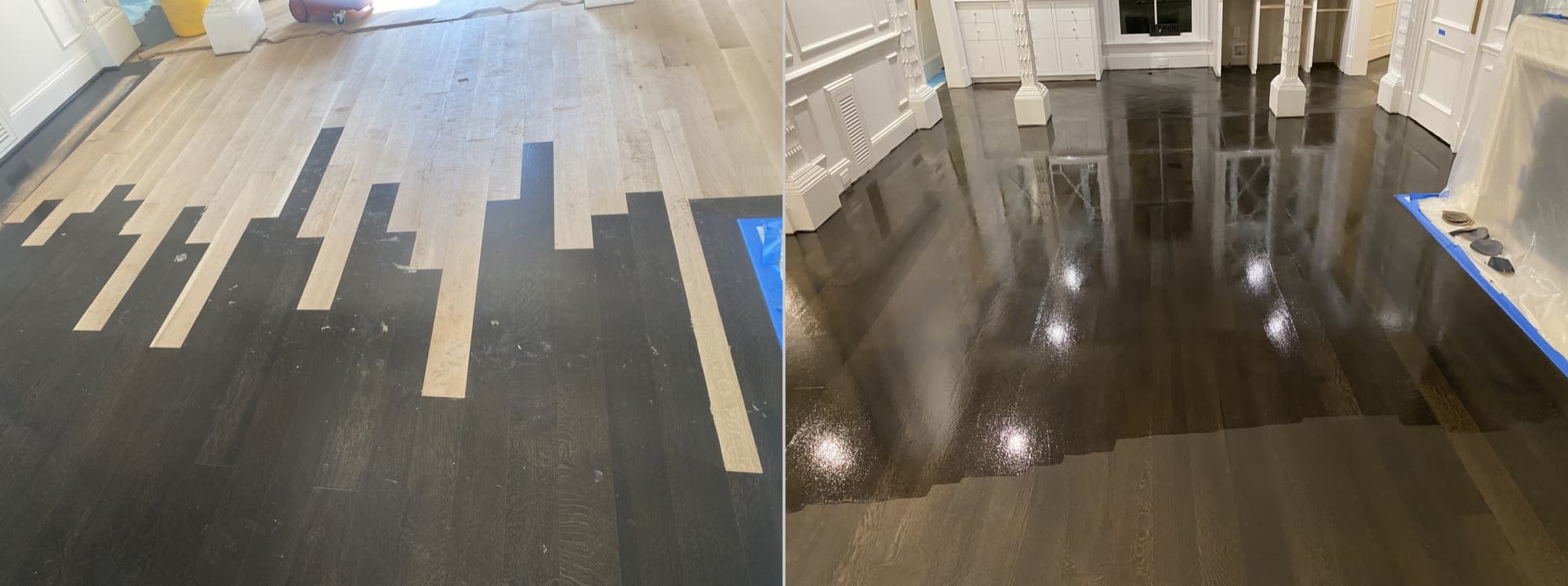
How to Choose
If the repair is in a closet, under furniture, or somewhere a color difference will not bother you, option A is a fair, honest choice, and we are glad to do it. If the area is in the middle of a room you see every day, option B is the one that makes the repair disappear. If the floor has more damage than the visible area, or you were already thinking about a new floor, option C is worth pricing. Water damage often travels farther under the boards than it shows on top, so we take moisture readings before recommending any of them. Our post on what to do in the first 48 hours after a water leak covers that part, and our cupping guide explains why a wet floor is never sanded.
Frequently Asked Questions
Can you patch a water-damaged hardwood floor so it does not show?
Yes, when we repair the damaged area and sand and refinish the entire floor together: that is how we guarantee a 100% match. Replacing boards alone, or refinishing only the damaged area, leaves a visible color difference, because the existing floor has aged and the new boards have not.
Can you refinish just the water-damaged area so it matches?
No. Refinishing only the damaged area leaves a visible difference from the surrounding floor. To guarantee a 100% match, we repair the damage and sand and refinish the entire floor together, including the existing flooring around the repair.
Can I use leftover boxes of the same flooring for a repair?
You can, and it is the least expensive repair, but expect the repaired area to be a different color. The installed floor has changed with age and sun exposure, while the boards in the box have been sitting in the dark. The species and product are the same; the color is not.
What is the only way to guarantee a hardwood repair matches?
We lace in replacement boards, then sand and refinish the entire floor as one surface, including the existing flooring around the repair, not just the damaged area. Sanding takes every board, new and existing, back to fresh wood, so they start the same color and age together from that day on. That is the only way we can guarantee a 100% match.
Does the width of the replacement boards have to match exactly?
Yes. A lace-in weaves new boards into the existing rows, so the new boards have to be the same width as the old ones. A 3 inch board will not weave into a 3-1/4 inch floor. We measure an existing board before ordering anything.
Why does cherry hardwood look different after a repair?
American cherry darkens noticeably with light over months, which is normal behavior for the species. An installed cherry floor will be much deeper in color than fresh cherry boards, so a cherry patch will stand out until the whole floor is sanded and the new and existing wood can age together.
How much does a hardwood floor repair cost?
A repair with boxed boards and no sanding carries a $1,000 minimum. A repair followed by sanding and refinishing the entire floor carries a $1,500 minimum on the whole job, repair and refinishing together. Above that, the refinishing is priced at $5.50 to $8.00 per square foot for existing hardwood, and the repair is priced from what we find. Your written proposal confirms the price for your floor and can show each option side by side.
Weighing a patch against a full refinish? Request a free estimate. We measure your boards, take moisture readings, and price each option side by side so you can choose with the trade-offs in front of you.
Water damage repairs where the match matters come up in kitchens, entries, and anywhere a leak meets a floor people see every day. We handle hardwood floor repair across the Triangle, including Raleigh, Apex, and Holly Springs. Request a free estimate and we will look at your floor in person before we talk numbers.