Hardwood floor refinishing takes 4 to 6 days: two days of sanding, half a day for stain, dry time included, if you are changing color, half a day for trim installation, and two days of finish coats. On a waterborne finish, furniture returns on felt pads 24 hours after the final coat and area rugs after 3 to 5 days. Smaller jobs land at the low end of that range; large homes, floors with heavy damage, and dark stains that need extra dry time run to the top of it.
That schedule holds whether we are refinishing in Raleigh, Clayton, Cary, or anywhere across the Triangle. What happens during those days, and what shifts the timeline, is worth understanding before you schedule.
The Standard Timeline: Day by Day
This is what a typical hardwood floor refinishing job looks like from start to finish on a residential home in the 800 to 1,500 square foot range. The process is the same whether we are working in Raleigh, Clayton, or Cary.
Day 1
Initial Sanding
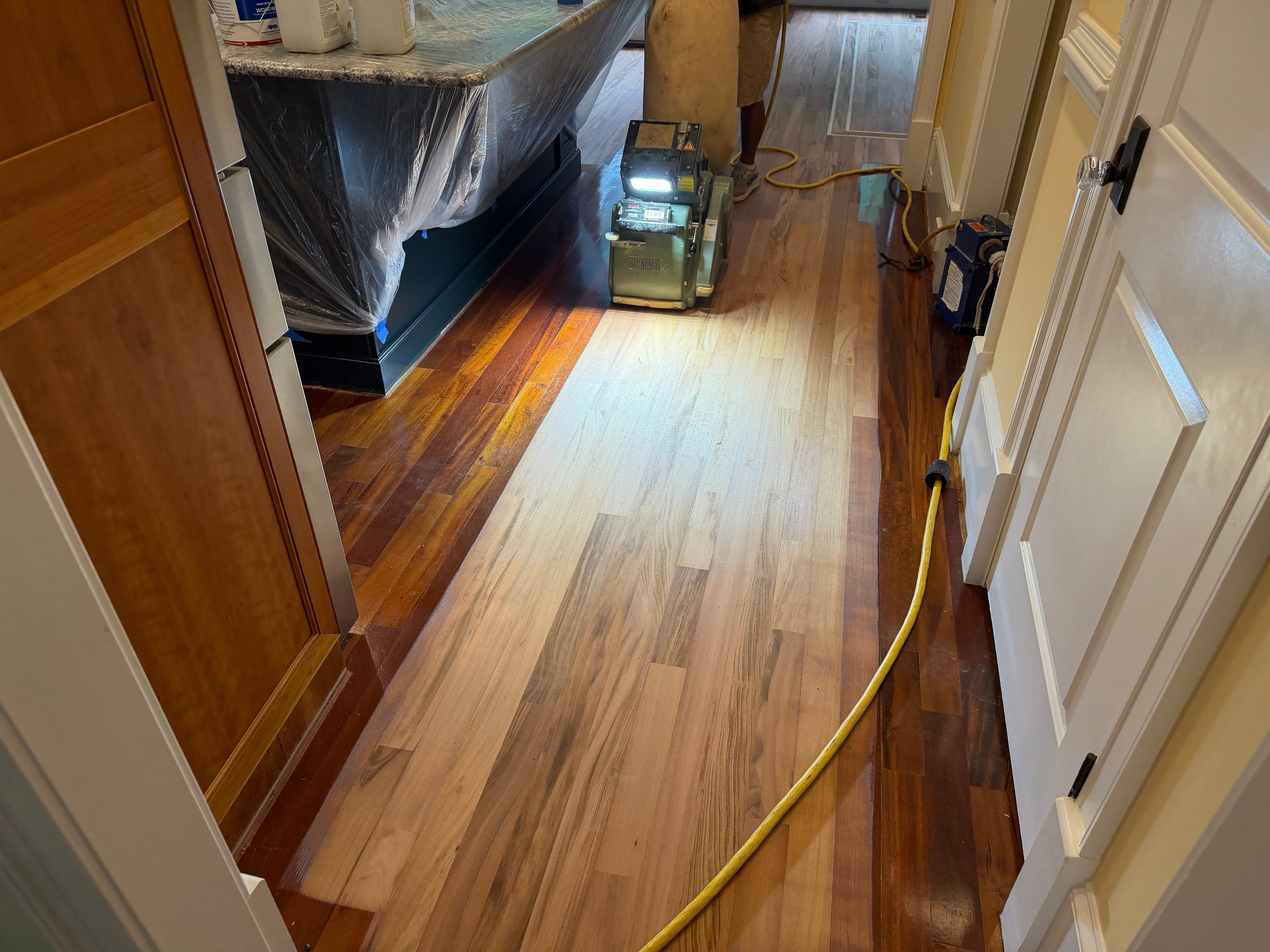
The first day is the most disruptive. Our Bona PowerDrive planetary sander makes multiple passes across the main field of the floor, cutting through the existing finish and removing surface scratches, staining, and discoloration down to bare wood. An edger works the perimeter, and detail work in corners and tight spots gets done by hand. By the end of day one, the floor is bare wood and the dust containment system has collected most of what came off. This is also when we assess whether any boards need repair or replacement before finishing proceeds. On older homes in areas like Raleigh or Clayton where floors may be 30 to 50 years old, finding boards that need lacing in is common and adds time to the overall schedule.
Day 2
Final Sanding Passes and Prep
The second day finishes what day one started. Progressively finer grits smooth the surface, remove any machine marks left by the earlier passes, and bring the wood to the right profile for stain or finish adhesion. The floor is vacuumed, tacked, and inspected carefully under raking light before anything goes down. On floors receiving a clear finish with no stain change, the first finish coat may go down on the afternoon of day two.
Day 3 (stained floors only)
Water Popping and Stain Application
For floors receiving a stain color change, stain goes down on day three. It is a half day of work plus dry time, not a full day of labor. We apply water popping before color first, which opens the wood grain to accept stain more evenly and deeply. Stain is applied, worked into the grain, and wiped. The floor then dries overnight before the first finish coat can go down. Skipping overnight drying between stain and finish is one of the most common mistakes that causes adhesion failures, so this step does not get rushed. This is especially important on red oak floors, which are common in older homes throughout Wake Forest, Garner, and Knightdale.
Day 3 or 4
First and Second Finish Coats
The first finish coat seals the wood and stain. It dries for several hours, then the surface is lightly abraded with a screen or fine abrasive pad to remove any dust nibs and improve adhesion for the next coat. The second coat goes down the same day or the following morning depending on dry times and job size. Most residential refinishing jobs receive a sealer coat and two coats of finish.
Day 4 or 5
Final Finish Coat
The final coat is applied, the floor is left to dry undisturbed, and the job is done from our side. We go over the cure timeline with you before we leave: when you can walk on it in socks, when shoes are fine, when rugs can go back, and when it is safe to move furniture back in.
Timeline by Project Type
Real-world durations from our own schedule, counted in working days on site:
| Project | Typical Duration |
|---|---|
| Refinish, clear coat (800 to 1,500 SF) | 4 to 5 days |
| Refinish with stain color change | 5 to 6 days |
| Recoat (screen and one fresh coat) | 1 day |
| Deep clean and polish removal | 1 day |
| New installation plus sand and finish (whole home) | 8 to 10 working days |
| Board repairs or lace-ins added to any job | add a half day to a day |
What Makes the Timeline Longer
The 4 to 6 day estimate applies to a straightforward job. Several factors can add time.
Staining vs. clear finish
Choosing a stain color adds approximately one day to the schedule. Stain needs to dry fully overnight before finish goes on top. Floors getting a clear or natural finish skip that step.
Square footage and room count
A single open-plan living area moves faster than a floor plan with many rooms, hallways, and closets. Each room boundary, doorway, and tight space adds hand work that the big machine cannot reach. Larger jobs may run a full day longer.
Floor condition
Floors with significant cupping, deep staining, or boards that need repair before sanding can add a half to a full day depending on scope. We assess condition during the estimate and call out anything that will affect timing before work begins. For a full breakdown of what drives cost and timeline together, see our guide on what affects hardwood floor refinishing cost, and for Clayton-specific pricing, the Clayton refinishing cost and timeline guide.
Number of finish coats
Most jobs get a sealer coat and two coats of finish. A hardwax oil finish is one coat. Each coat adds dry time and an abrasion pass between coats, so the coat count is built into the schedule.
Dry Time vs. Cure Time: Why the Distinction Matters
The floor will feel dry to the touch long before it has reached full hardness. Dry time and cure time are not the same thing, and confusing them is how finishes get permanently damaged.
Dry time is when the surface has hardened enough for foot traffic without marking. On a waterborne finish that is about four hours for socks; shoes wait a day. Cure time is when the finish has completed its chemical cross-linking and reached its final hardness rating. That takes longer.
| Finish System | Light Traffic | Full Cure |
|---|---|---|
| Bona Traffic HD | Socks at 4 hours | 3 days |
| Bona Mega One | Socks at 4 hours | 5 days |
| Rubio Monocoat | 36 hours | 5 days |
Furniture placed without felt pads on a finish that is dry but not cured can leave permanent dents. Area rugs trap moisture and can cloud the finish if laid down too early. Both situations are avoidable by respecting the cure window. Among the finishes we carry, Traffic HD has the fastest full cure at 3 days. The hardwax oils take a little longer to reach full hardness but can be spot-repaired down the road, something no polyurethane offers. We recommend both tiers equally; the right choice comes down to look, lifestyle, and how you want the floor to age. For a deeper look at how each finish system performs, see our Bona Traffic HD vs. Rubio Monocoat comparison.
What to Do Before We Arrive
The more prep done before day one, the faster the job moves. A few things to handle before the crew arrives:
Clear the rooms completely
All furniture, area rugs, and decor need to be out of the rooms being refinished. We can help move large pieces for an additional charge, but the job moves faster when rooms are already empty.
Remove fragile items from shelves and walls
Sanding creates vibration throughout the floor structure. Items that can fall or shift should be taken down in the work area and adjacent rooms.
Plan for the floor to be out of use
Map out a path through the house that avoids the refinished area. If the entire main level is being done, plan to use a different entrance and keep the kitchen accessible or arrange for meals elsewhere during finish coat days.
Secure pets
Paws and claws on a fresh finish coat leave marks. Keep pets in a separate area of the house or off-site during the work and for 24 hours after the final coat. If you can keep them off until full cure, that is better.
Is Recoating Faster?
Yes, significantly. Hardwood floor recoating is usually done in one day because there is no sanding to bare wood. The existing finish is lightly screened to degloss it, a fresh topcoat is applied, and the job is done. The tradeoff is that recoating cannot address deep scratches, staining, or discoloration, and it cannot change the stain color. It is the right service for a floor whose finish is wearing thin but whose wood is still in good condition.
We offer recoating throughout the Triangle, including Raleigh, Clayton, Cary, Wake Forest, Apex, and Garner.
If you are not sure which service your floor actually needs, the signs your floors need refinishing guide walks through the water test and visual indicators that point toward recoating vs. a full refinish.
Hardwood Floor Refinishing in the Triangle
12th And Oak Floor Co. has been refinishing hardwood floors across the Raleigh metro since 2002. The timeline and process described above applies to every job we do, regardless of location. If you want city-specific information including pricing context and what to expect for your area, visit the page for your city:
Questions and Answers
How long does it take to refinish hardwood floors?
A professional hardwood floor refinishing job takes 4 to 6 days from start through the final finish coat. That includes two days of sanding, half a day for stain including its dry time if color is being changed, half a day for trim installation, and two days for finish coats. Smaller jobs land at the low end; very large homes and floors with heavy damage run to the top of the range.
How long do I need to stay off hardwood floors after refinishing?
On a waterborne finish (Bona Traffic HD, Mega One) you can walk on the floor in socks four hours after the final coat. Keep shoes and pets off for the first 24 hours, and keep pets off until full cure if you can. On hardwax oil, keep foot traffic to a minimum for the first 24 hours and walk only on the pads or rags we leave for you; normal walking is fine at 36 hours. Area rugs go back after 3 to 5 days on a waterborne finish and 5 days on hardwax oil, because a rug restricts airflow and slows curing, and trapping moisture under it can cloud the finish.
Can I sleep in my house during hardwood floor refinishing?
For the sanding phase, most homeowners stay in the home as long as the refinished rooms are sealed off and you have a clean path to a bedroom and bathroom. On finish coat days, the odor from water-based finishes is mild enough that most people stay home with windows open. Oil-modified polyurethane is significantly stronger and often requires leaving for 24 to 48 hours. We use water-based finishes exclusively, so staying home on coat days is usually fine.
Does staining add time to the refinishing process?
Yes, by roughly one day. After sanding is complete, stain is applied and needs to dry fully before the first finish coat goes down. That typically means an overnight wait, which shifts the finish coat schedule by a day. Floors receiving a clear finish with no stain skip that step entirely.
How long before I can put furniture back after refinishing?
Furniture goes back on felt pads 24 hours after the final coat on a waterborne finish (Bona Traffic HD, Mega One) and 36 hours on hardwax oil. Lift pieces into place rather than sliding them; a finish that looks dry has not reached full hardness yet, and dragging a sofa across it is how the first scratch happens.
What is the difference between dry time and cure time for hardwood floor finish?
Dry time is how long before you can walk on the floor without leaving marks. Cure time is how long until the finish reaches its full hardness and chemical resistance. A finish can be dry in four hours but still be soft enough to scratch or dent until it has cured. Respecting cure time protects the finish from permanent damage before it has fully hardened.
For technical standards on finish systems, cure times, and professional application practices, the National Wood Flooring Association publishes installation and finishing guidelines used by certified contractors throughout the industry.
Ready to Get Started?
Schedule Your Free Estimate
Izral Daniels walks every job in person before quoting. He serves Raleigh, Clayton, Cary, Wake Forest, Garner, Apex, Knightdale, Fuquay-Varina, Holly Springs, Wendell, Zebulon, Selma, Smithfield, and Durham. He will assess your floors, give you an honest recommendation, and walk you through the timeline specific to your home.
Request Free EstimateWant the schedule for your own house? Request a free estimate. We measure, confirm the finish, and give you the day-by-day plan with the proposal.
The schedule above is what we tell clients before we start, and it is what we hold to. We handle hardwood floor refinishing across the Triangle, including Fuquay-Varina, Wendell, and Wake Forest. Request a free estimate and we will look at your floor in person before we talk numbers.