
What Water Popping Is
Water popping is the process of lightly misting bare, freshly sanded hardwood with water immediately before applying stain. That is the entire mechanical description, and it is a standard step in our refinishing process on every floor we stain. What it does to the wood is significant.
When a hardwood floor is sanded down to bare wood, the abrasive action compresses and partially closes the wood fibers at the surface. This is unavoidable. The finer the grit used on the final sanding pass, the more closed and burnished the surface becomes. Closed fibers absorb stain unevenly. The result is a blotchy, patchy stain application where some areas of the grain take color deeply and others barely accept it at all.
Water reverses this. When water contacts the compressed wood fibers, they swell and stand up, a process called grain raising or "popping" the grain. The surface becomes microscopically more open and receptive. Stain applied to a water-popped floor penetrates deeper, more evenly, and produces richer, more consistent color throughout the grain.
How Long to Wait After Water Popping Before Staining
Wait until the floor is completely dry, not just dull. In a conditioned house that is usually 30 to 60 minutes. On a humid summer day with the air off, plan on longer, sometimes two hours or more. The test is simple: the surface has no sheen left anywhere, and the wood feels room temperature and dry to the back of your hand, including in corners and along walls where water pools.
Staining too early is the one mistake that cannot be fixed without re-sanding. Water still in the grain thins the stain, the color comes out blotchy and light, and the sealer can react. If you are unsure, wait. Nothing bad happens to a water-popped floor that sits an extra hour. Just keep everyone off it, because a footprint in the raised grain will show through the stain.
How to Water Pop a Floor, Step by Step
- Finish sanding completely, vacuum, and tack the floor. Water popping is the last thing before stain.
- Use clean water only, no additives. A pump sprayer or a damp T-bar applicator both work.
- Wet the floor evenly, working with the grain, and keep a wet edge so you never overlap a dry area. Overlaps and puddles become dark lines under stain.
- Do not walk on it. Plan your path so you finish at the exit.
- Let it dry completely, as above.
- Stain the same day. A water-popped floor left overnight collects dust and can flatten back down.
What It Looks Like in Practice
After the final sanding pass and before any stain is applied, we lightly mist the floor with water using a pump sprayer, enough to dampen the surface evenly without puddling. The wood darkens slightly as the fibers absorb the moisture. You can see the grain open in real time.
We wait for the floor to dry back to its original color, typically 30 to 60 minutes depending on humidity, temperature, and the species. Once dry, the grain remains in a more open, receptive state. Stain is applied immediately. The window between water popping and staining matters. Wait too long and the fibers close again.
Timing and even application are what separate a properly executed water pop from one that makes things worse. Too much water in one area, uneven drying, or applying stain before full drying will create exactly the blotchiness the technique is meant to prevent.
Before vs. After: What You Actually See
The visual difference between a water-popped floor and one stained directly after sanding is most apparent in two places: the consistency of color across the grain, and the depth of color in the open-pored areas. The photo below is a real sample from a job. Same floor, same stain, same application. The only variable is water popping.
Without Water Popping
- ·Stain color appears uneven across the board face
- ·Hard summer grain reads lighter than soft spring grain
- ·Visible striping or blotching, especially on dark stains
- ·Color looks thin or flat rather than rich and absorbed
- ·Grain detail obscured rather than enhanced by the stain
With Water Popping
- ·Color is consistent across the full board face
- ·Summer and spring grain accept stain at the same rate
- ·Dark stains read as intended, rich and saturated
- ·Color depth is visible: the wood has genuinely absorbed it
- ·Grain is enhanced and three-dimensional under the finish
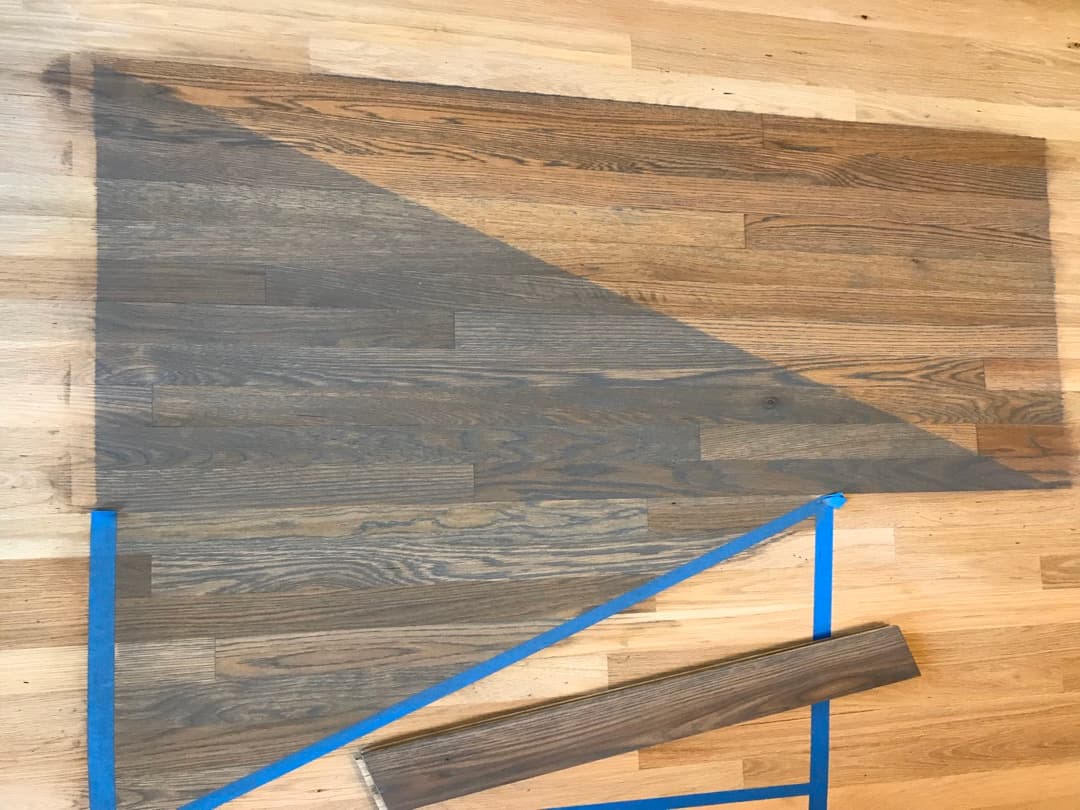
The difference is most dramatic on dark stains (espresso, jacobean, ebony) applied to red oak. On those floors, the grain opens dramatically and accepts pigment at a depth that is simply not achievable without the water pop step. For lighter stains on white oak, the effect is subtler but still present: more even tone, cleaner edges between grain lines, more consistent color room to room.
Our portfolio case studies include several stained projects with before-and-after documentation showing exactly this. The Turner Downs ceruse project and several dark-stained red oak refinishes in Clayton and Raleigh are the clearest examples.
Red Oak vs. White Oak: Why Species Matters
Water popping produces more dramatic results on red oak than white oak, and this is worth understanding before you choose a stain color.
Red oak has a more open, porous grain structure. Its rays and pores are larger. Water popping significantly amplifies stain penetration on red oak. The grain opens wide and accepts color deeply. This is part of why red oak with a dark stain can look so rich and dramatic. The wood is genuinely taking the color in.
White oak has a tighter grain and, crucially, its tyloses (waxy deposits that fill the pores) partially block deep stain penetration even after water popping. White oak still benefits from the technique. Color is more even and consistent, but the depth difference between popped and unpopped is less pronounced than on red oak. White oak also holds lighter, more neutral tones more cleanly than red oak, which is part of why it has become the dominant choice for contemporary interiors. Read our full white oak vs. red oak guide →
What Happens When You Skip It
A floor stained without water popping on a properly fine-sanded surface will frequently look uneven. The hard summer grain and soft spring grain accept stain at different rates. The result is a striped or blotchy appearance. Not because the stain is bad, but because the surface was not prepared to receive it evenly.
The only remediation for an uneven stain is to sand the floor back down and start over. There is no topcoat or finishing technique that fixes a stain that went on wrong. This is why we treat water popping as a non-negotiable step on every stained floor during hardwood floor refinishing. Not an upgrade or an add-on.
When you are evaluating refinishing contractors, ask them directly: Do you water pop before staining? If they do not know what you are asking, or if they say it is not necessary, that is meaningful information about the quality of their process.
Is Water Popping Worth It?
Yes. But let's be specific about what "worth it" means, because that is a real question with a real answer.
Water popping adds time to the job. The application takes 15 to 20 minutes for a typical floor. Then you wait 30 to 60 minutes for the floor to dry before stain can go down. On a job with multiple rooms, that is a meaningful addition to the schedule. That time is built into our estimates. It is not charged as a separate line item, but it is not free. Contractors who skip it are faster. That speed is a business decision, not a technical one.
What water popping buys you is stain that performs the way it was designed to. Stain manufacturers formulate their products assuming the wood has been properly prepared for penetration. When you skip water popping, you are applying a penetrating product to a surface that is actively resisting penetration. The stain sits on the surface rather than absorbing into it. The color is shallower, the coverage is inconsistent, and the result looks like what it is: a compromise.
For light stains (natural, white wash, very pale gray) water popping has less visual impact and is sometimes skipped intentionally when the goal is to minimize color variation. For any medium, dark, or specialty stain, it is not optional if you want the result to look correct.
The economic argument is simple: you are paying for a full refinishing project, sanding, staining, and three to four coats of finish over four to six days. The stain is the most visible part of that investment. If the stain goes on wrong, the entire project looks wrong, and the only fix is to start over. Water popping is the step that ensures the most visible result of the job is correct on the first application.
We have never gone back to resand a floor because the water pop was done correctly and the stain went on wrong. We have seen other contractors' floors that needed to be completely redone because water popping was skipped. The math is not complicated.
Water Popping and Finish Systems
Water popping applies specifically to the staining step and affects how stain penetrates and looks. It does not directly interact with the finish system applied afterward, whether that is Bona Traffic HD, Bona Mega One, or Rubio Monocoat. The finish goes over the dried, stained wood regardless.
However, water popping does indirectly affect finish performance. A stain that penetrates evenly creates a more consistent base for the finish to bond to. Blotchy stain, especially where areas of the grain are heavily saturated and others barely colored, can affect how uniformly the finish builds and how consistent the final sheen appears across the floor.
The relationship between water popping, stain, and finish is one of the reasons we sequence our refinishing process in Raleigh the way we do: dustless sanding to bare wood, water pop, stain, and then finish coats applied after full stain cure. Each step depends on the one before it being done correctly.
Our Practice
We water pop before every stained floor we refinish, without exception. It adds time to the job. Both the application and the wait for the floor to dry are built into every estimate we give. It is not a line item or an upgrade. It is part of the process.
This applies equally to white oak and red oak floors, to new hardwood installations being finished on site for the first time, and to existing floors being refinished after years of wear. If stain is going down, water popping happens first.
If you want to see what properly water-popped stain looks like, our portfolio case studies include several stained projects with before-and-after documentation. The Turner Downs ceruse project is a good example of what intentional stain layering looks like when the prep work is done correctly.
Questions about your specific floor? Our in-home assessment covers species, current finish condition, and stain options. See our Raleigh refinishing page for the full process breakdown, or request an estimate.
Questions and Answers
What is water popping in hardwood floor refinishing?
Water popping is lightly and evenly wetting a freshly sanded floor to raise and open the wood grain before staining. Open grain accepts more stain, so the color goes in deeper, darker, and more evenly than it would on a tightly sanded surface.
Is water popping necessary before staining?
For dark and richly pigmented stains on oak, it makes the difference between a deep even color and a floor that looks thin and blotchy. For natural and clear finishes with no stain, it is unnecessary. We decide based on the color you have chosen, not as an automatic step.
Can water popping damage a hardwood floor?
Done correctly, no. The water is applied evenly and the floor dries fully before stain. The risks come from doing it unevenly, which shows as blotchy color, or from touching the popped surface before staining, which burnishes spots closed. This is technique work, which is why it belongs in experienced hands.
Does water popping work on both red oak and white oak?
Yes. Both species take noticeably deeper, more even color after popping. It is one of the reasons a professionally stained oak floor looks richer than the same stain applied straight to a machine-sanded surface.
Do you water pop every stained floor?
We water pop when the chosen color calls for it, which in practice is most medium and dark stain jobs. It is part of our staining process rather than an add-on: the goal is that the color in your house matches the depth of the sample you approved.
Can you water pop quarter sawn oak?
Yes. Quarter sawn oak has tighter grain and dramatic ray fleck, and water popping evens how the stain takes across those two textures. It can make the fleck read slightly darker than on plain sawn boards, which most people like. We test a board first when the floor mixes cuts.
What happens if you walk on a water-popped floor?
The raised grain compresses where your foot lands, and that spot takes less stain. It shows as a lighter footprint under the finish. If it happens, re-wet that area and let it dry again before staining.
Planning a stained refinish? Request a free estimate. We water pop every stained floor and show you the color on a sample board before we commit.
Water popping is a standard step on our darker stain jobs, and the sample board shows you the difference before we commit. We handle stain color selection on your own floor across the Triangle, including Raleigh, Holly Springs, and Zebulon. Request a free estimate and we will look at your floor in person before we talk numbers.