
Owner · Bona Certified Craftsman · NWFA Member
Every fall, a week or two after the furnace starts running, we get the same text: the floors have gaps that were not there in August. Almost every time the answer is the same. Nothing is wrong with the floor. The wood is drying out with the house, and it will close back up when the humidity returns in early summer. This is what that cycle is, how to tell a seasonal gap from a real one, and how to make the winter lines smaller without doing the one thing that makes them worse.
Wood moves with the air in the house
A hardwood board is never finished drying. It takes on moisture when the air is humid and gives it back when the air is dry, and it changes width as it does, mostly across the grain. A board that is 5 inches wide in July is a little narrower in January. Multiply that small change by every board in a room and the total has to show up somewhere, and where it shows up is the seams.
North Carolina makes the swing wide. Summer air here is heavy, and without a dehumidifier or a well-run air conditioner the indoor humidity in a Triangle home sits well above the range wood likes. Then the heat comes on. Warm air holds more moisture than cool air, so heating dry fall air drops the indoor humidity hard, often into the twenties in a house with no humidifier. The boards give up water to that air and pull away from each other. By late spring the process runs the other way and the gaps close. If your floor has done this every year since it was installed, it is doing what wood does.
Which floors gap the most
Wide planks
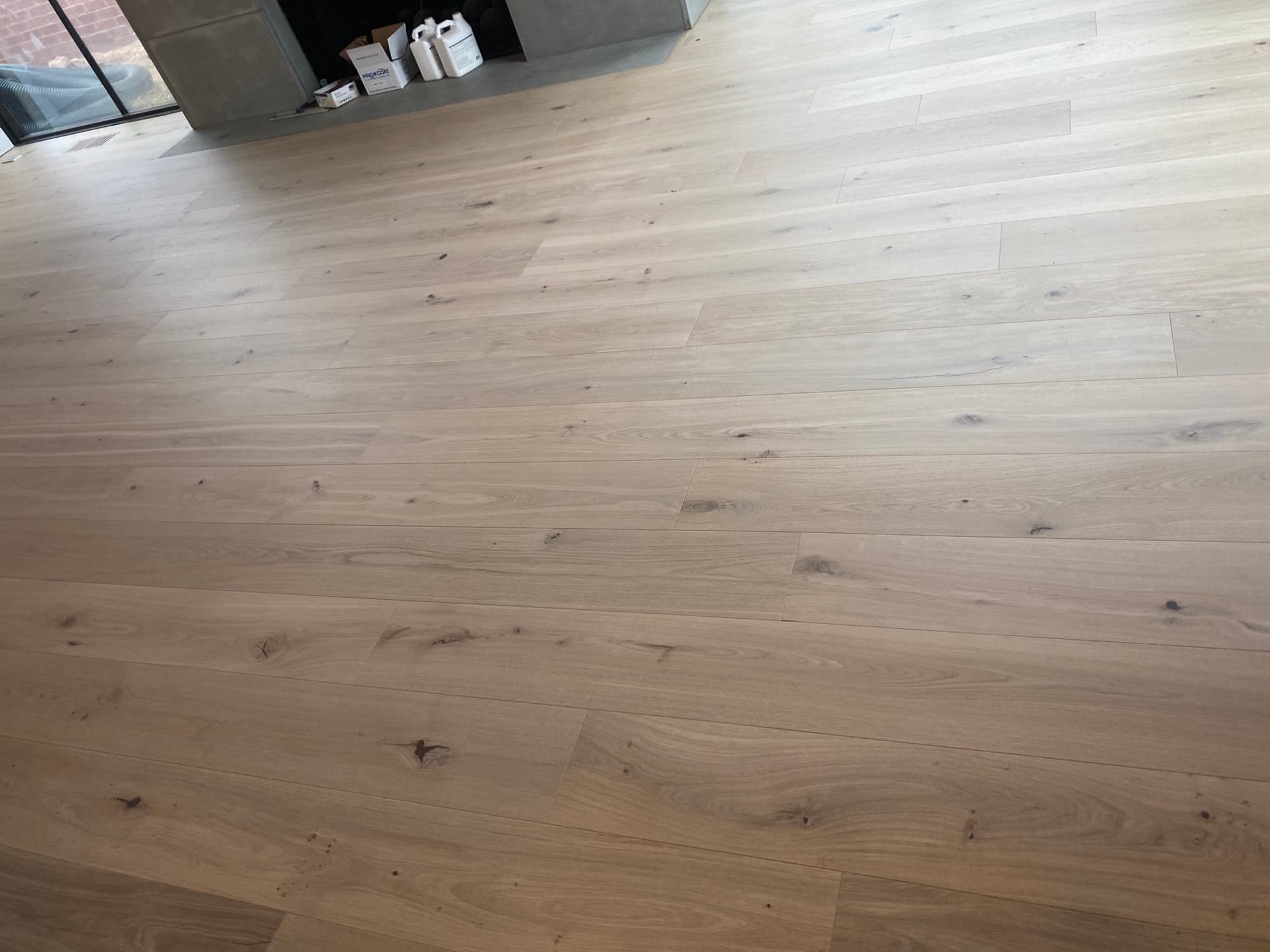
Movement is proportional to width. The 5, 7, and 9 inch planks that are popular now show gaps that a strip floor from 1995 never did, in the same house with the same air.
Plain-sawn boards
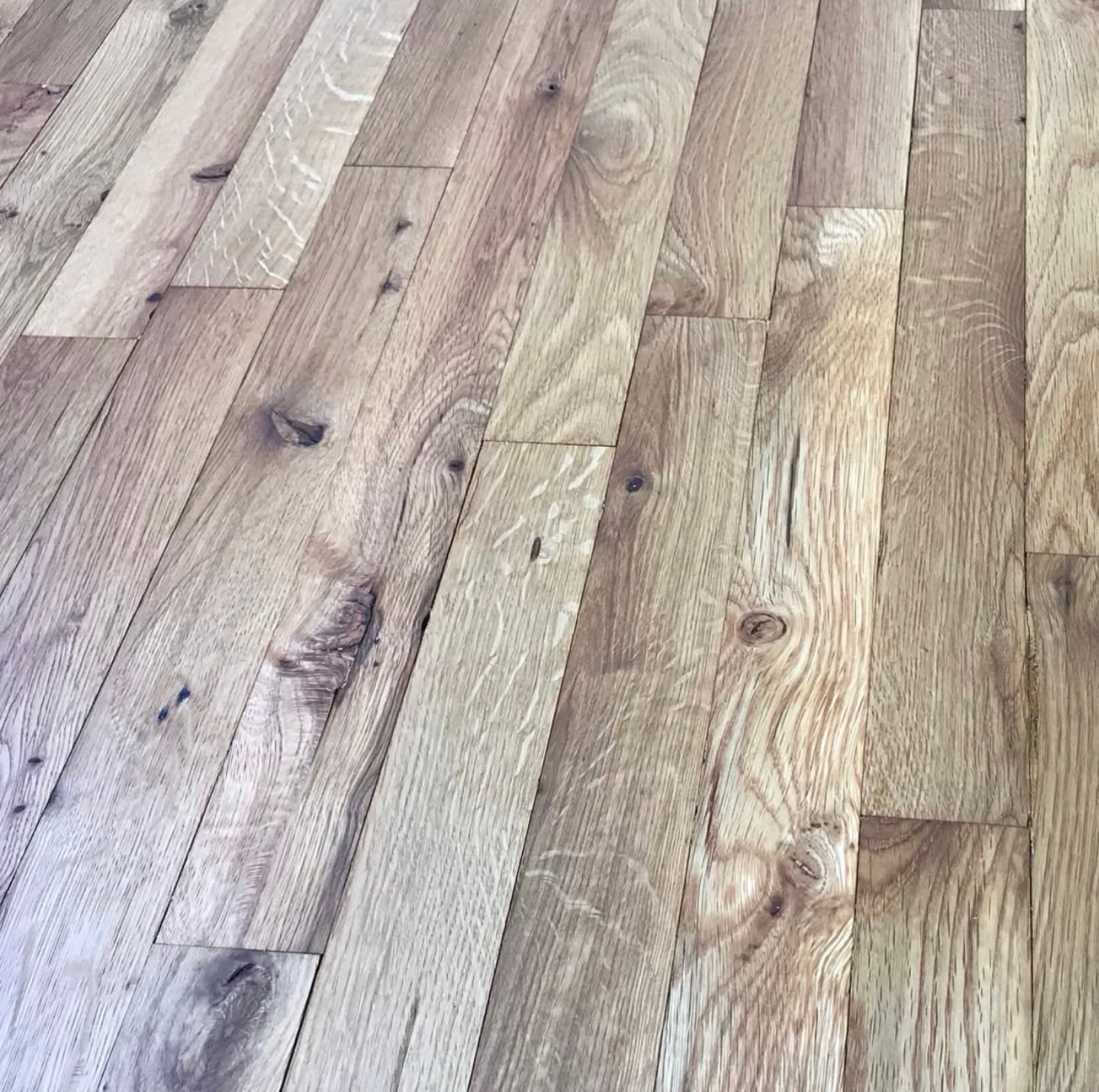
Most flooring is plain sawn, with the growth rings running flat across the face, and that cut moves the most across its width. Rift and quartered white oak, with the rings standing on end, moves about half as much and is the choice when a client wants wide boards and quiet seams.
Solid over engineered
A solid board is one piece of wood moving in one direction. An engineered board is a real wood face on a plywood core with its layers turned against each other, which fights the movement. Engineered floors still open a little in winter, but noticeably less.
Floors finished in a humid month
A site-finished floor sanded and coated in July was sanded with the boards at their widest. The first winter after that, every seam opens. A floor finished in October or April started closer to the middle.
Houses with no humidity control
A whole-house humidifier and a sealed crawl space are the two things that narrow the swing. Homes without either see the biggest difference between their August floor and their January floor.
The one thing not to do: fill them
Every fall someone buys a tube of wood filler and goes seam by seam. Please do not. A seasonal gap is a gap because the boards on either side of it are going to swell back into that space in June. Filler in the way has nowhere to go. It either cracks and crumbles out over the winter, leaving a gap with a dirty white edge, or it holds and the boards crush against it and push it up into a ridge you can feel with a sock. Caulk is worse, because it smears into the finish and never comes back out cleanly.
Filling has a place, and that place is during a refinish, on gaps that hold the same width all year. When we sand a floor we trowel filler across it and sand it back flush, and on a stable floor that fill stays put for the life of the finish. On a floor that swings hard with the seasons, we talk about timing first: sanding and filling in April or October catches the boards near the middle of their travel, so the fill is not fighting a full summer swell or a full winter shrink.
What actually helps
You cannot stop wood from moving, but you can shrink the distance it moves by narrowing the humidity swing in the house. The National Wood Flooring Association guideline is 30 to 50 percent relative humidity and normal living temperatures, all year. A twenty dollar hygrometer on a shelf tells you where your house actually sits, and most Triangle homes are surprised by both ends. We recommend a second one in the crawl space, and this is the one that matters: a sensor that reads humidity and temperature down there and reports to your phone or to a display upstairs. Nobody goes into the crawl space to look. A sensor that tells you it hit 80 percent in July, before the floor does, is the cheapest floor protection there is.
| Season | What the floor is doing | What helps |
|---|---|---|
| October to March | Drying and shrinking as the heat runs; gaps open | A whole-house humidifier on the furnace, set to hold the house in the 30s or low 40s |
| April to May | Taking moisture back; gaps close | Nothing. Watch them close. This is the best window to sand and fill if a refinish is due |
| June to September | Swollen and tight; a floor that was gapped in January is seamless now | Run the air conditioning enough to keep humidity under 50, or add a dehumidifier; seal or condition the crawl space |
The crawl space matters more than most people expect. A large share of the homes we work in around Raleigh and Clayton sit over a vented crawl space, and in summer that space is a swamp under the floor. The boards pick up moisture from below faster than the air conditioning can pull it out above. A sealed vapor barrier, or a fully encapsulated and conditioned crawl space, evens out the whole year and is the single biggest fix for a floor that goes from tight to gapped and back. Some crawl spaces are wet for reasons that have nothing to do with the season: bad drainage, a yard graded toward the foundation, or groundwater pushing up under hydrostatic pressure. Those stay damp in January too, and a floor over one behaves strangely all year, cupping in one room and gapping in another. That is an encapsulation with a dehumidifier running, and when water is coming in, a French drain and a sump pump before it is a flooring job.
When a gap is a real problem
Seasonal gaps are even, they are everywhere in the room, and they come and go with the calendar. A gap that breaks any of those rules is telling you something else.
It is still there in August
A gap that never closes is not seasonal. The usual cause is a floor installed with boards that were too wet and have since dried and shrunk for good, or a floor installed too dry in a house that then got drier. Those gaps get filled during a refinish, and the floor settles down after.
One gap is much wider than the rest
Often a board that was never fully engaged in its tongue and groove, or the last row against a wall that was left proud. A single wide seam can be repaired on its own.
The gaps run along a wall or across a doorway
That is the floor moving as a whole, not each board a little. It usually means the expansion gap at the wall is gone or the floor was fastened poorly, and it can lead to buckling in summer.
The floor also cups, squeaks, or feels loose underfoot
Gaps plus cupping is a moisture problem from below. Gaps plus movement underfoot is a subfloor or fastening problem, and usually a squeak with it. Both need a look before the season changes and hides the evidence.
If you are not sure which kind you have, take a photo of the same seam in January and again in July. That pair of photos answers the question better than any visit. And if the gaps bother you enough to act, the answer is almost never filler and almost always humidity, or, on a floor that is due anyway, a properly timed refinish. Our cupping guide covers the other direction the same moisture can push a floor, and our squeak guide covers what loose boards sound like.
Questions and Answers
Why do my hardwood floors have gaps in the winter but not in the summer?
Wood takes on moisture from humid air and gives it back to dry air, and it changes width as it does. Summer air in North Carolina keeps the boards swollen and tight. When the heat comes on in the fall, indoor humidity drops, the boards give up moisture and shrink across their width, and thin lines open between them. By early summer they have taken the moisture back and the gaps close. That cycle is normal for a solid wood floor.
Should I fill the gaps in my hardwood floor?
Not if they open and close with the seasons. Filler put into a winter gap has nowhere to go when the boards swell back in summer. It either crumbles out or gets squeezed up into a ridge, and either way it looks worse than the gap did. Filling makes sense for small gaps that stay the same size all year, and it is done as part of a refinish, not on its own.
How wide is a normal seasonal gap?
On a standard 2 1/4 inch strip floor, a gap you can slide a credit card into but not a dime is ordinary winter movement. Wider planks move more, so a 5 inch plank floor can show gaps roughly twice as wide and still be behaving normally. A gap that swallows a coin, or one that is there in August, is worth a look.
What humidity should I keep my house at for hardwood floors?
The National Wood Flooring Association guideline is 30 to 50 percent relative humidity and normal living temperatures, year round. Most Triangle homes run well above that in summer and well below it in a heated winter without help. A whole-house humidifier on the furnace, and a dehumidifier or a sealed crawl space in summer, narrow the swing and shrink the gaps.
When is a gap not seasonal?
When it is there in the humid months too, when one gap is much wider than its neighbors, when gaps run alongside a wall or a doorway rather than spread evenly across the room, or when the floor also cups, squeaks, or feels loose. Those point to how the floor was installed, moisture from below, or a subfloor problem, and they do not fix themselves in June.
Is it better to refinish hardwood floors in summer or winter?
For a floor that moves a lot with the seasons, the shoulder months are kindest. Sand and fill in the dead of winter and the filler gets crushed when the boards swell. Sand in the wettest part of summer and the filler cracks when they shrink. Spring and fall catch the boards near the middle of their swing, so whatever is filled stays put longer.
Gap widths and timing above are what we see on floors in Wake and Johnston County homes, not a laboratory figure. Humidity and installation standards follow the National Wood Flooring Association guidelines.
Not Sure Which Kind of Gap You Have?
Send us a few photos of the seams and tell us when they showed up. Most of the time we can tell you it is seasonal from the pictures and save you the visit. When it is something more, we come look, measure the moisture in the floor and under it, and tell you exactly what it needs. Serving Raleigh, Clayton, Cary, Wake Forest, Garner, Apex, Knightdale, Fuquay-Varina, Holly Springs, Wendell, Zebulon, Selma, and Smithfield.
Send Us PhotosSeasonal gaps are the most common floor question we get every fall, in every town we work in. We handle hardwood floor repair across the Triangle, including Raleigh, Clayton, and Cary. Request a free estimate and we will look at your floor in person before we talk numbers.