
Owner · Bona Certified Craftsman · NWFA Member
We get more calls about squeaks than about any other floor problem, and the honest answer to most of them is not the one people want. A squeak is two things rubbing when you step: wood against a nail, wood against wood, plywood against a joist. Which two things, and where, decides whether it is a twenty minute fix from the crawl space, a job we can quote, or a chase that no one can honestly put a price on. This is how we sort them.
Everything that can be moving
A floor is a stack. Joists carry a subfloor, the subfloor carries the flooring, and each layer is fastened to the one below it. A squeak means one of those connections has loosened, or the whole stack is being pushed by moisture. In our experience across Wake and Johnston County homes it is almost always one of these.
The hardwood moving on the subfloor
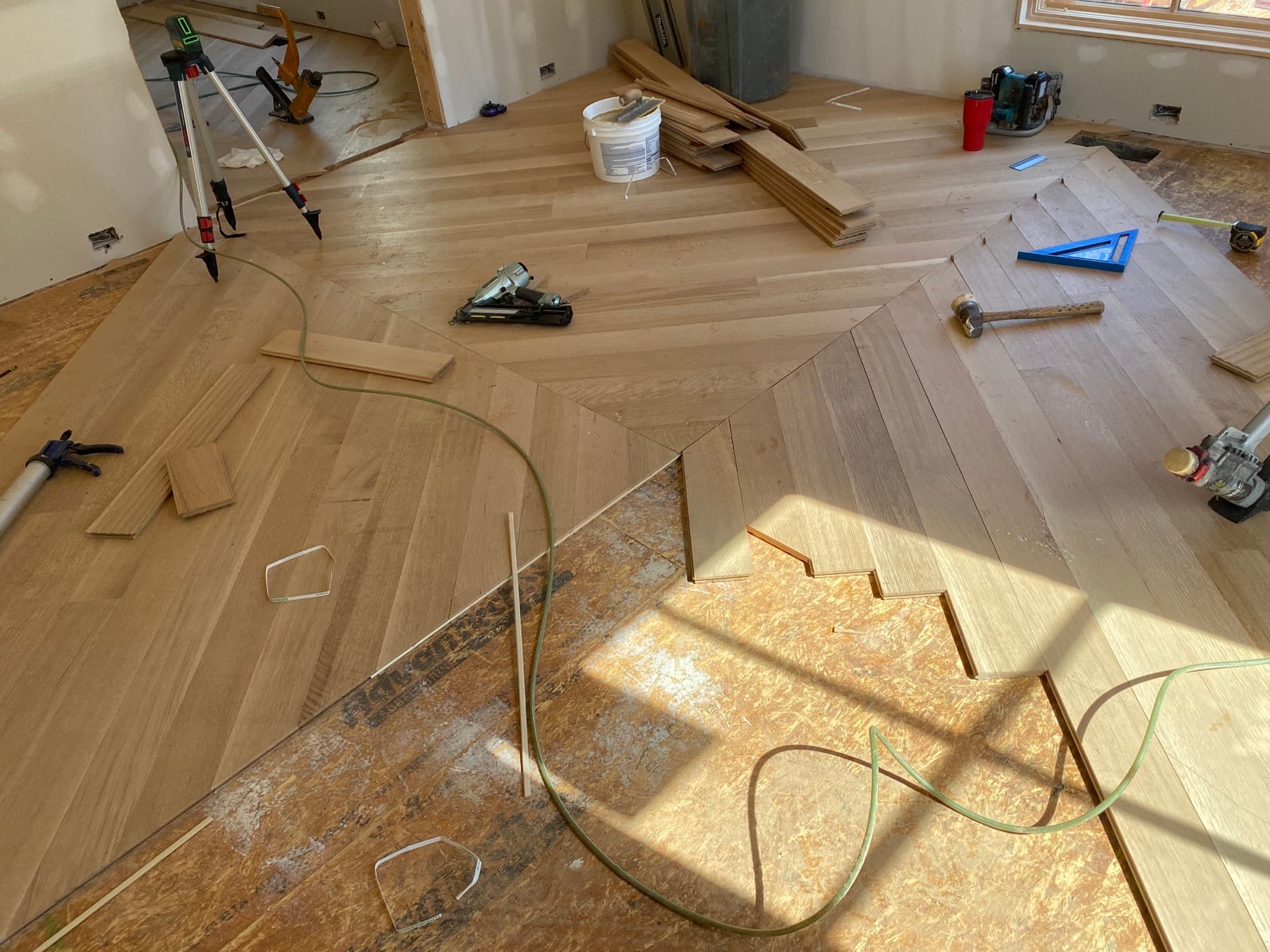
Solid strip and plank floors are nailed or stapled through the tongue into the subfloor. Over years of seasonal swelling and shrinking those fasteners lose their bite, the board gets a little play, and it squeaks as it slides on the nail shank or rubs its neighbor. This is the classic squeak and the one we hear most.
The wrong fasteners, or too few of them
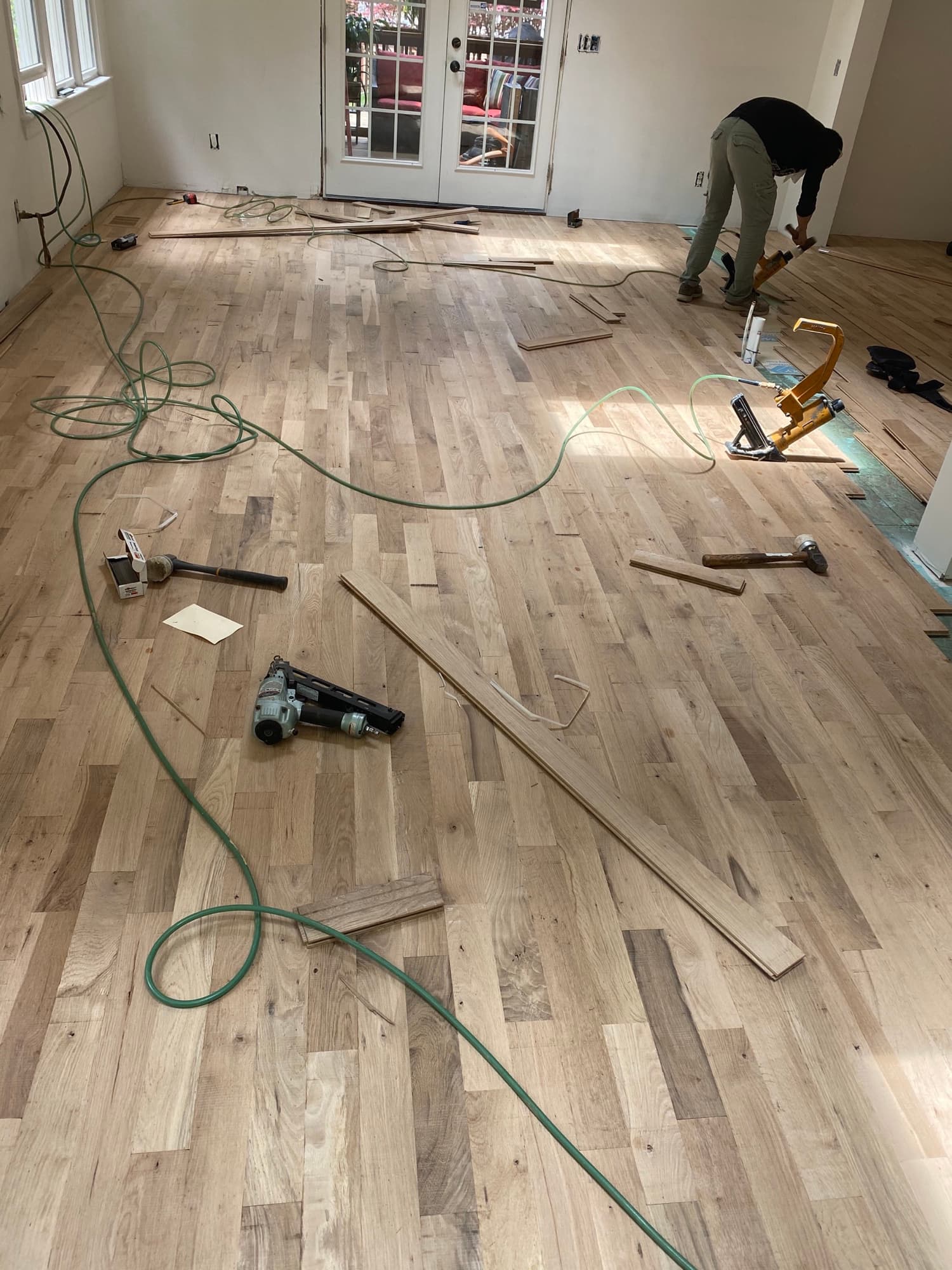
Some floors squeak from the day they were installed. Fasteners spaced too far apart leave every board free to flex between them. Staples, which many crews use because they are fast, split and crush the tongue instead of holding it, and a split tongue holds nothing. On very hard and exotic species like Brazilian cherry, hickory, and some of the imported woods, a standard cleat can bust the tongue outright, and every busted tongue is a board that will move for the life of the floor. We only install with cleat nails, never staples, drop to an 18 gauge cleat on the species with breakable tongues instead of the 16 gauge we use on oak, and glue and nail anything 5 inches wide and over, and most floors 4 inches and over, so the board is held by the whole face and not just the fastener.
The subfloor moving on the joists
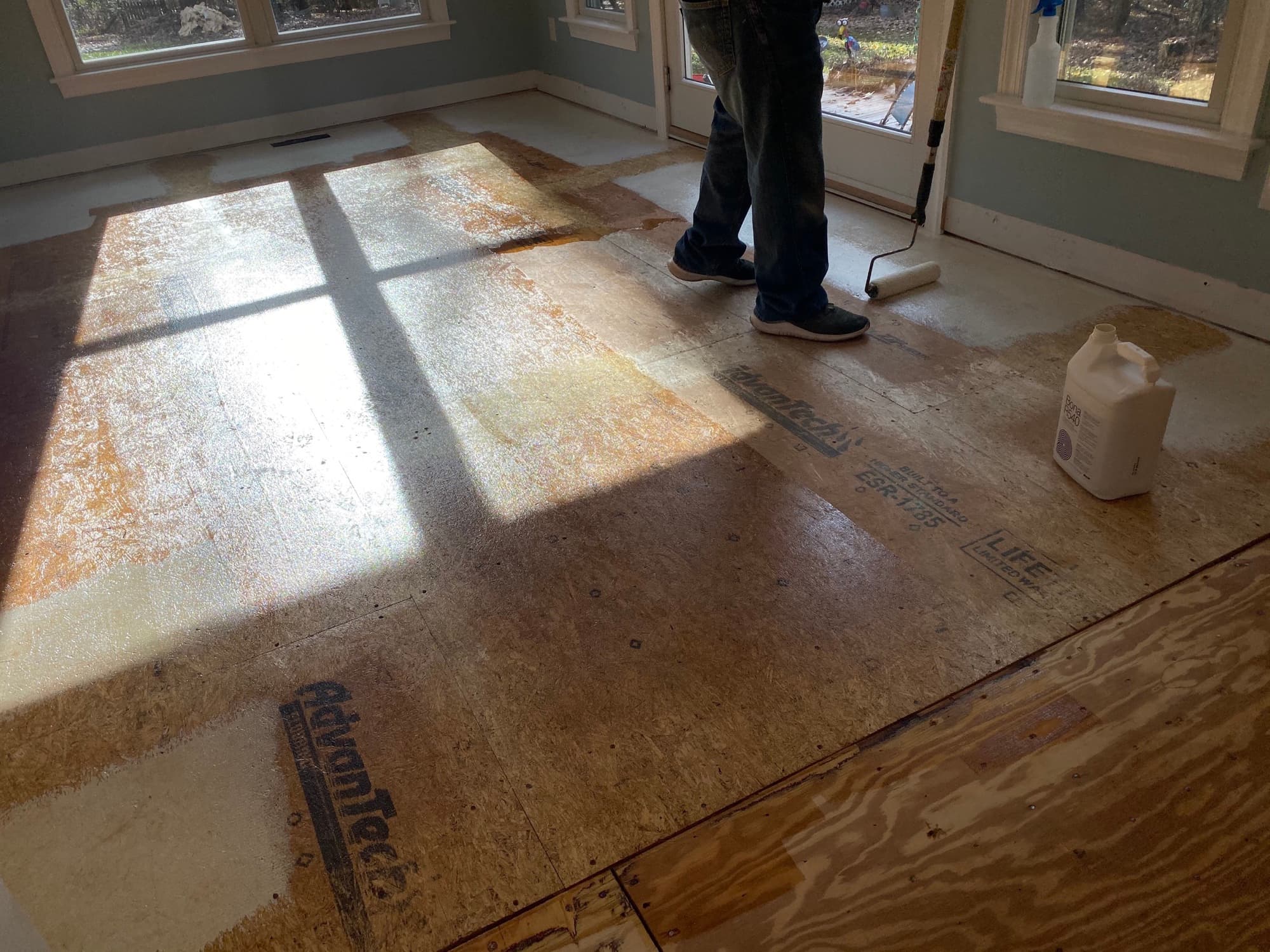
Plywood or OSB nailed to joists without glue, or nailed when the joists were wet, backs off the joists as the lumber dries and shrinks. Step on that spot and the sheet drops onto the joist and rides back up, and the nails squeal in their holes. The hardwood on top can be perfectly tight and the floor still squeaks, because the noise is a layer down.
Moisture from below
Most homes around here sit over a vented crawl space, and in summer that space is humid enough to swell a hardwood floor from underneath. The boards push against each other, cup, and in bad cases buckle. That pressure works fasteners loose, and when the wood dries back in winter the loosened boards are free to move and squeak. Moisture is how a quiet floor becomes a noisy one. And not all of it is seasonal. A crawl space with bad drainage, a yard graded toward the house, or groundwater pushing up under hydrostatic pressure stays wet all year, and a floor over it never gets a dry season to recover in. Those crawl spaces need to be encapsulated with a dehumidifier running, and when water is actually coming in, a French drain and a sump pump to move it out. Until that is done, nothing done to the floor holds.
A floating floor with no room to grow
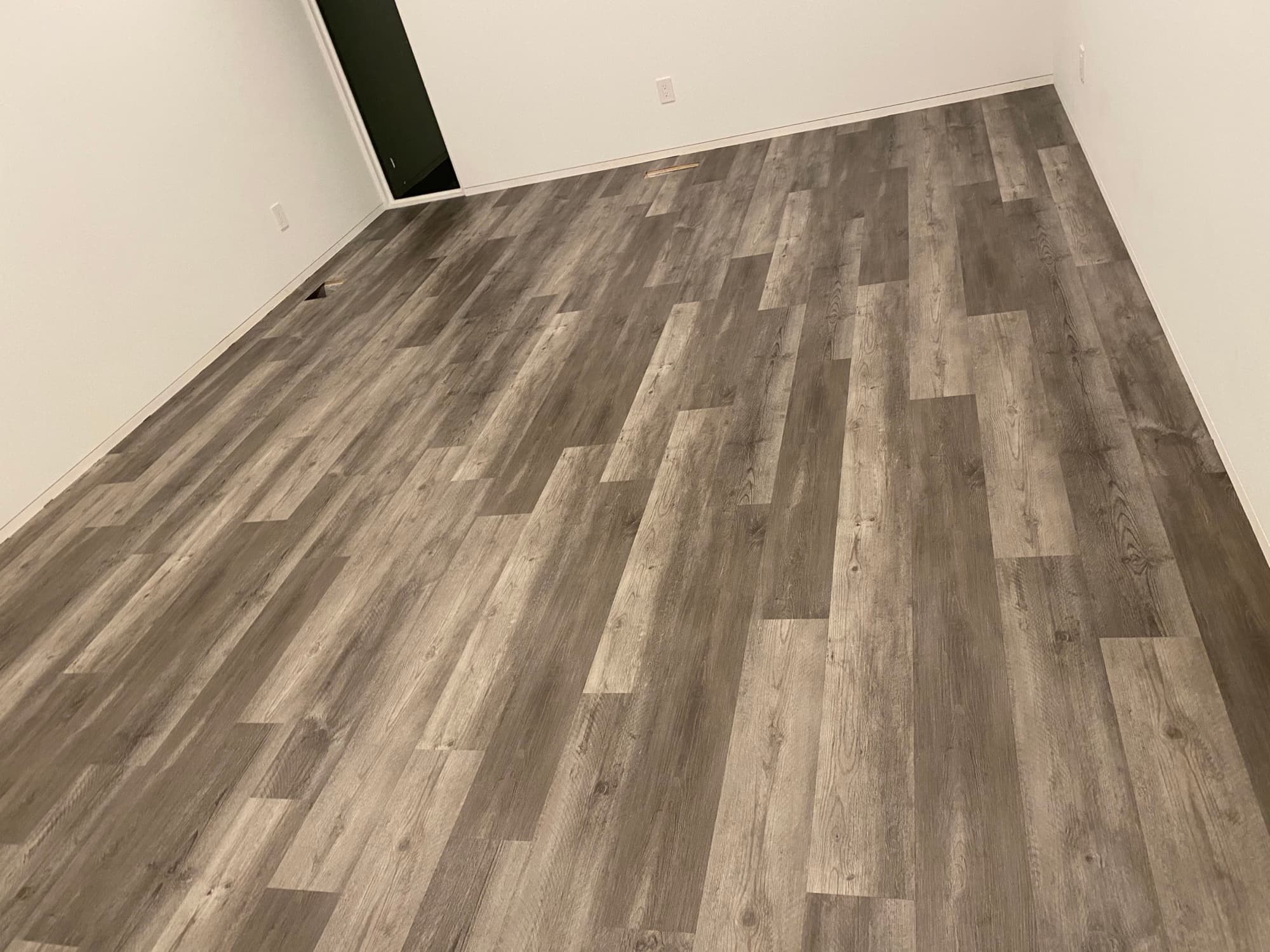
Laminate and vinyl plank are not fastened at all. They float, and they need a gap at every wall to expand into. When that gap is missing, or the shoe molding was nailed down through the planks, the floor grows in summer until it jams against the walls. Every joint is then under pressure, the planks grind on each other, seams peak, and the floor creaks and shifts underfoot. A hollow spot under a floating floor, where the subfloor dips and the planks flex over air, makes the same noise.
Springy spans and missing blocking
A long joist span with no bridging between joists flexes under load. Nothing is loose, the whole assembly is just bouncing, and everything fastened to it talks when it does.
A loose wall plate, nowhere near your foot
The bottom plate of a wall sits on the subfloor and is nailed through it. When that nailing has loosened, walking anywhere on that stretch of floor flexes the subfloor under the wall and the plate pops or squeaks against it. The sound can come from many feet away from where you are standing, which is why people swear the noise is moving around the room. Look at the wall, not the board.
Two clues you can read yourself
How much weight it takes to make the noise tells you which layer is moving. Stand on the spot and just shift your weight. If that is enough, and a child walking through sets it off too, it is almost always the hardwood moving on the subfloor: a board with a little play sliding on its nail. If it takes your full weight, a bounce, or two people, the noise is usually a layer down, the subfloor dropping onto a joist and riding back up. Light weight, hardwood. Heavy weight, subfloor. It is not a law, but it is right often enough that it is the first thing we do on a visit.
The second clue is where the sound comes from. A hardwood squeak is under your foot. A subfloor squeak can be a step or two away. A pop or squeak that comes from across the room, or from the base of a wall, when you walk a certain path is a wall plate or a joist talking, and no amount of fastening the boards where you are standing will touch it. Walk the room slowly and listen for the source before you decide where the problem is.
Squeaks that come and go with the seasons
Before anyone reaches for a drill, listen to the calendar. Wood shrinks in a heated house and swells in a humid one, so a board that sat tight against its nails in August can have a hair of play in January, and play is noise. A squeak that shows up when the furnace starts running and fades by June is telling you the humidity swing is too wide, the same thing that opens the winter gaps between boards. Narrowing that swing, with a humidifier in winter and a dry crawl space in summer, quiets more floors than fasteners do. It also stops the swing from loosening more of them.
What can be done from underneath
When the squeak is in one place and there is a crawl space or basement under it, there is real work we can do without touching the finished floor. Someone walks the spot upstairs while someone else is underneath finding it, and then:
Screws up through the subfloor
Short screws driven up through the subfloor into the hardwood pull a loose board back down tight. Length is everything. Too long and the tip comes through your finish.
Blocking between joists
Solid blocks cut to fit between the joists under a bouncy span stiffen the whole area. It is the fix for a floor that is not loose so much as lively.
Shims and adhesive
Where the subfloor has lifted off a joist, a glued shim fills the gap so the sheet cannot drop and ride back up. Construction adhesive along the joist does the same for a longer run.
Brackets
Purpose-made brackets pull the subfloor down to the joist from below when there is nothing to shim against.
This works, and it makes a lot of floors much better. What it cannot do is promise silence. We can only fix the squeaks we can reproduce while we are under there, the ones that speak up when the weight is in the right place. The one that only sounds off at 6 a.m. in February when you step in from the hallway at a certain angle may not perform on the day. And a floor with squeaks all over is not a spot repair. It is a chase.
Why squeak chasing cannot be quoted
Here is the part we say on the phone that surprises people. We will not give a flat price for chasing squeaks from underneath, and we would be careful of anyone who does. The same floor can take two hours or two weeks. You fix the three squeaks you found, walk the room, and the load path shifts to the next loose spot, which was quiet before because the first three were carrying it. There is no way to know from the top how many are down there, and nobody can see through a subfloor. We do this work by the hour, the homeowner sets the limit, and the agreed goal is better, not silent. That is the truthful version, and it is the one we would want told to us.
The only fix that is one hundred percent
On a hardwood floor there is exactly one way to get rid of every squeak and know it: take the flooring up, screw the subfloor back down to every joist, deal with whatever the subfloor is doing while it is exposed, and put the floor back down. With the wood off, a moving subfloor can be blocked, glued, shimmed, and bracketed from above where we can see it, and a sheet that has delaminated can be replaced instead of guessed at. Then the hardwood goes back on with the right fasteners at the right spacing, glued as well as nailed on wide planks, into a subfloor that no longer moves.
That is a real job with a real price, because it can be measured. It is also the same first step as a new floor, which is why it usually comes up when a floor is being replaced anyway, or when a client has decided the squeaks are worth more to them than the boards. For a floor that is due to be refinished, there is a middle path: on the day we sand, before the first pass, we can fasten loose boards from the top and the sanding takes the evidence with it. That catches the squeaks we can find with the finish still on, which is more than we can find from below and less than a full removal. Our refinishing visits start with a walk for exactly this reason.
Floating floors are a different repair
A creaking laminate or vinyl plank floor is not a fastener problem, because there are no fasteners. It is a pressure problem. The fix is to pull the base shoe, cut the edge planks back to a proper expansion gap at every wall and doorway, free any place the floor was pinned by a cabinet, a transition strip, or a nail through the plank, and let the floor relax. If the creak is a flex rather than a grind, the subfloor under that spot is low and the planks are bridging air; that needs the floor lifted back to the spot and the dip filled. Neither one is a crawl space job. Our LVP care guide covers what a floating floor needs after that.
What to do before you call anyone
Note when it squeaks
Winter only points to humidity. Year round points to fasteners or subfloor. After a wet summer or a plumbing leak points to moisture that has already done its work.
Note how much weight it takes
A shift of your weight is enough: probably the hardwood. Your full weight or a bounce: probably the subfloor. And notice whether the sound is under your foot or somewhere across the room.
Take a video with sound
Walk the spot with your phone recording. A ten second clip with the squeak audible, and a wide shot so we can see where in the room it is, tells us more than a paragraph.
Look underneath if you can
A flashlight in the crawl space shows whether the plywood is lifting off a joist, whether there is blocking, and whether the ground is wet. You do not have to fix anything. Just seeing it decides the plan.
Put a sensor down there
We recommend every house on a crawl space have a way to read the humidity and temperature under the floor without crawling in: a sensor that reports to your phone or to a display upstairs. If the number is high, the squeak is a symptom and the crawl space is the job.
Check the other symptoms
Cupping, a soft or bouncy spot, gaps that never close, or a floating floor with seams peaking up all change the answer.
If cupping is part of the picture, read our hardwood floor cupping guide first, because fastening a floor that is still wet only holds it in the wrong shape. And if the floor is otherwise sound and the squeak is one spot over a crawl space, that is a good candidate for an hour underneath. We will tell you which one you have from the video, and we will tell you plainly when the honest answer is to live with it.
Questions and Answers
Why do my hardwood floors squeak?
Something is moving against something else when you step. Either the hardwood is moving on the subfloor because its fasteners have lost their grip, the subfloor is moving on the joists because its nails have backed out or the plywood has separated, or, on a floating floor, the planks have grown tight against the walls and are grinding on each other. Finding which one is the whole job.
Why do my floors squeak more in winter?
Humidity. Wood shrinks in a heated house, so boards that were tight against their nails in August have a little room to move in January, and movement is noise. The same floor often goes quiet again by June. A squeak that follows the seasons is a humidity swing first and a fastener problem second, and a humidifier can do more for it than a screw gun.
Can squeaky hardwood floors be fixed without removing the floor?
Often they can be made much better. From a crawl space or basement we can drive screws up through the subfloor into the hardwood, add blocking between joists to stiffen a springy span, and shim or glue a subfloor that has lifted off a joist. That fixes the squeaks we can reach and reproduce. It does not fix the ones we cannot, and on a whole floor of them it turns into a chase. The only way to promise silence is to take the flooring up and screw the subfloor back to the joists.
How much does it cost to fix squeaky floors?
A full fix, removing the floor, refastening the subfloor, and reinstalling or replacing the wood, is a job we can measure and quote. Chasing squeaks from underneath is not. It can take two hours or two weeks, and any flat price for it is a guess. We do that work by the hour with the homeowner setting the limit, and we say up front that the goal is better, not guaranteed silent.
Why is my new laminate or vinyl plank floor creaking?
Floating floors need a gap at every wall to grow into in summer. When that gap was left out, or filled with shoe molding nailed through the planks, the floor swells, locks against the walls, and puts pressure on every joint. The result is creaking underfoot, peaking at the seams, and sometimes a buckle. The fix is to cut the edges back to a real gap and let the floor relax, plus flattening any low spot in the subfloor the planks are flexing over.
How can I tell if it is the hardwood or the subfloor squeaking?
Weight. If shifting your weight on the spot is enough to make the noise, it is usually the hardwood moving on the subfloor, a board with a little play on its nail. If it takes your full weight or a bounce, the subfloor is usually moving on the joist. Also notice where the sound comes from. Under your foot is the board. A step away is the subfloor. Across the room or at the base of a wall is a loose wall plate or a joist, and the fix is there, not where you are standing.
Can a floor squeak because it was installed wrong?
Yes, and those are the floors that squeak from the first winter. Fasteners spaced too far apart, staples that split the tongue instead of gripping it, or a standard cleat driven into a very hard species that busts the tongue all leave boards that were never held. We install with cleat nails only, an 18 gauge cleat on hard and exotic species with breakable tongues in place of the 16 gauge we use on oak, and glue plus nails on planks 5 inches and wider, usually 4 and wider, so the wood is held by its whole face.
Do squeaks mean something is structurally wrong?
Usually not. Most squeaks are a nail that has lost its bite or a sheet of plywood that has come loose. A floor that squeaks and also bounces, sags, or cups is worth a closer look, because that combination points to a moisture problem below or a subfloor that has failed, and those get worse on their own. A crawl space that is wet year round, from poor drainage or groundwater, is the one to take seriously: the floor cannot be fixed until the crawl space is, usually with encapsulation, a dehumidifier, and where water comes in, a French drain and sump pump.
Causes and fixes above are what we find in the homes we work in, not a laboratory list. Installation and fastening standards follow the National Wood Flooring Association guidelines.
Got a Squeak?
Send us a short video with the sound on and tell us when it started. From that we can usually say whether it is a humidity swing, a spot repair from underneath, or a floor that needs to come up, and what each one means before anyone drives out. Serving Raleigh, Clayton, Cary, Wake Forest, Garner, Apex, Knightdale, Fuquay-Varina, Holly Springs, Wendell, Zebulon, Selma, and Smithfield.
Send Us a VideoSqueaks are the most common repair call we get, in every town we work in. We handle hardwood floor repair across the Triangle, including Raleigh, Clayton, and Garner. Request a free estimate and we will look at your floor in person before we talk numbers.