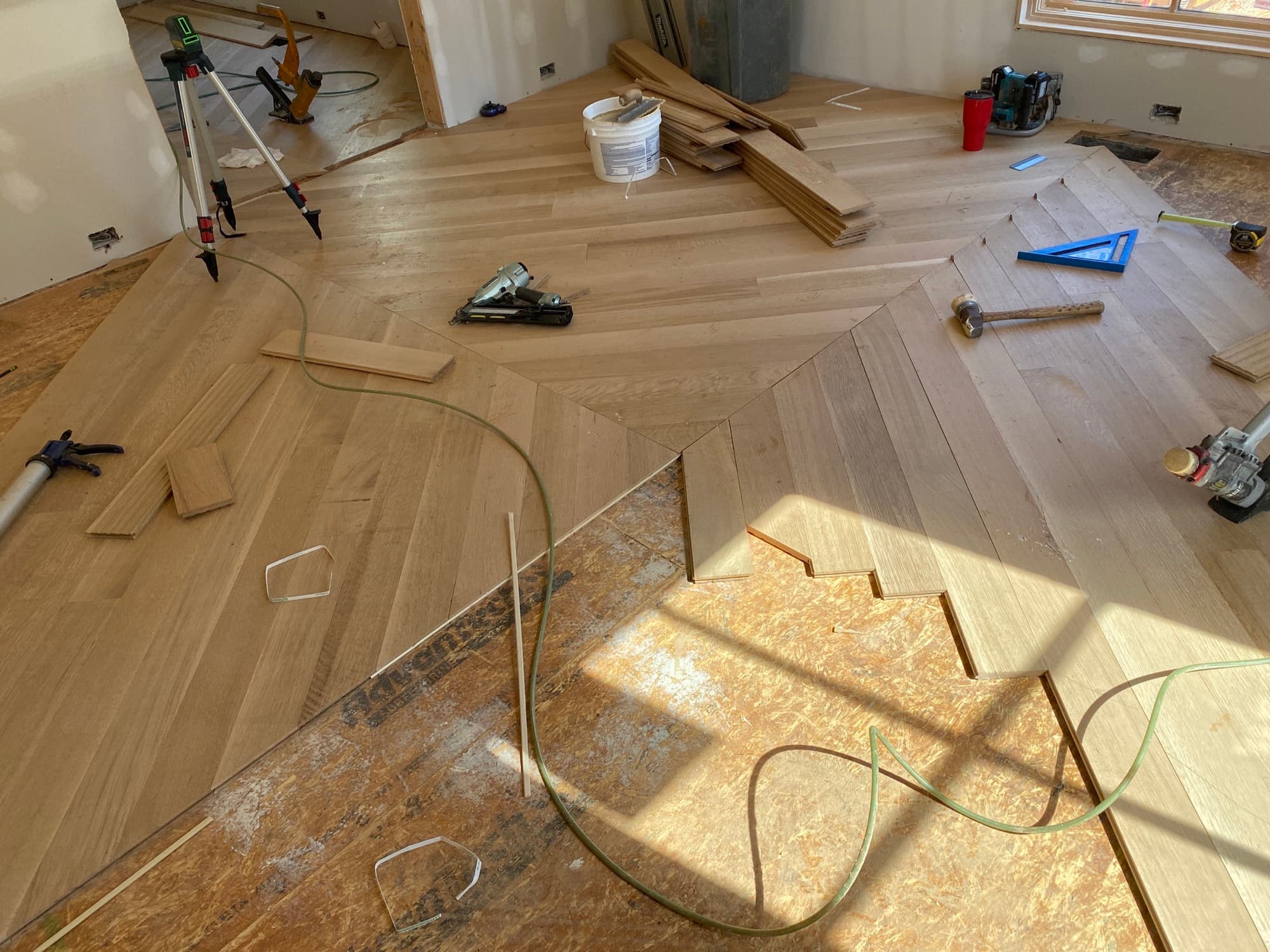

Hardness: The Difference Is Real but Modest
White oak scores 1,360 on the Janka hardness scale. Red oak scores 1,290. That is a 5.4% difference, meaningful in a direct comparison but not dramatic enough to be a deciding factor on its own. Both species are harder than pine (870 Janka) and softer than hickory (1,820 Janka) or Brazilian cherry (2,350 Janka). For the full chart and what the test actually measures, see our Janka hardness guide.
In practical terms, both species will dent from dropped heavy objects, scratch from furniture being dragged, and show wear from pets over time. The difference between red oak and white oak hardness will not determine whether your floors survive dog traffic, finish choice, sheen level, and regular refinishing maintenance matter far more. For a deeper look at finish durability, see our finish comparison guide.
Grain: The Most Visible Difference
This is where the two species diverge most clearly to the eye. Red oak has larger, more open pores and prominent ray fleck, the characteristic swirling or flowing grain pattern that most people picture when they think of hardwood floors. It is expressive and warm. In older Triangle homes built from the 1960s through the 1990s, the vast majority of original hardwood is red oak.
White oak has smaller, tighter pores and a more linear grain pattern. The medullary rays in white oak are longer and more pronounced, producing a subtle figuring that is particularly visible on quarter-sawn and rift-sawn cuts. The overall effect is quieter and more contemporary, which is exactly why white oak has become the dominant specification for new construction and renovation in Raleigh's higher-end neighborhoods over the past decade.
Stain Behavior: Where the Choice Really Matters
Red oak and white oak behave differently under stain, and this difference can override the design intent if you are not aware of it.
Red oak's open pores and large rays create dramatic contrast when stained. Dark stains like Ebony, Jacobean, or Early American look rich and deep on red oak because the grain absorbs color heavily. The warm pink undertone of red oak can show through lighter stains, which is why gray and whitewash tones are harder to achieve cleanly on red oak, the warm undertone fights the cool pigment.
White oak's tyloses partially block stain penetration into the pores, which counterintuitively makes it better for cool, neutral, and light stains. Grays, bleached tones, and raw natural finishes read cleaner on white oak. The species takes dark stains, but the result can look flatter and less dramatic than the same stain on red oak. White oak also accepts ceruse (liming) and wire-brushed finishes particularly well because the grain texture provides clear visual channels for the effect.
In both cases, proper water popping before stain application is essential for even color. Red oak benefits more dramatically from water popping than white oak due to its more open grain structure.
Wide Plank: White Oak's Current Advantage
Wide-plank flooring, 5 inches and above, has become the dominant new installation specification in upscale Raleigh neighborhoods including North Hills, Midtown, Five Points, and Wakefield. White oak is the species of choice for wide plank for several reasons.
White oak's tyloses give it better dimensional stability than red oak, meaning it is less prone to cupping, gapping, and movement across wide planks in response to humidity changes. This matters significantly in North Carolina, where summer humidity routinely exceeds 70%. A 7-inch white oak plank is substantially more stable than a 7-inch red oak plank under the same conditions.
White oak wide-plank is also more readily stocked by premium hardwood suppliers. We source through Ten Oaks, our primary supplier, and white oak availability in 5, 6, and 7-inch widths is consistently better than red oak in those widths.
Matching Existing Floors: Red Oak Almost Always Wins
If you are extending hardwood into a new room, matching floors from a repair, or doing a lace-in after an addition, and the existing floor is red oak, you need to match with red oak. There is no visual equivalent across species. The grain patterns, pore structures, and base tones are different enough that white oak installed next to red oak will always be visible as a different wood, regardless of stain color.
The vast majority of Triangle homes built before 2005 have original red oak. When we do hardwood floor repair in Raleigh or board replacements in older neighborhoods, we source matching 2¼″ or 3¼″ red oak strip flooring through Ten Oaks specifically because the grain and pore structure need to read as continuous. The same rule governs a full lace-in, where new boards are woven into an existing floor with no transition strip.
What the Price Difference Actually Is
The cost gap between the two species is real and it is bigger than most people expect. On a 966 square foot house in Clayton we quoted this month, the same floor in #1 Common red oak came out about $2,100 lower than in #1 Common white oak. Same width of material ordered, same grade, same finish, same crew. The boards were also different widths, 4-1/4 inch white oak against 2-1/4 inch red oak, and that was not the reason. Width moves the price very little; species is the lever.
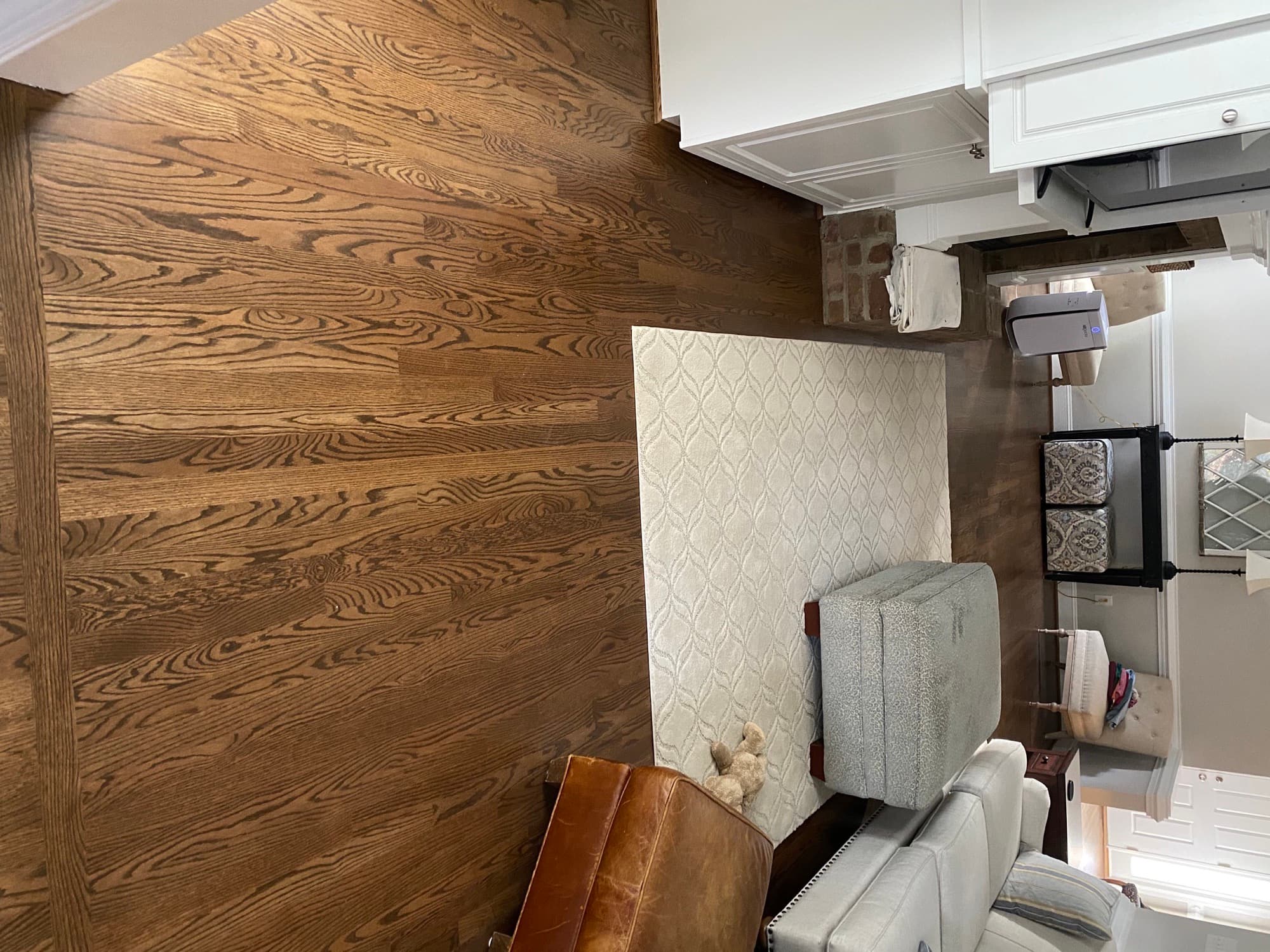
If your existing floors are red oak, the cheaper species is also the one you can blend into with a lace-in. If you want the wide plank, gray-friendly look, white oak is worth the difference. Either way, ask for both prices on the proposal.
What We Recommend
For new hardwood floor installation in Raleigh and surrounding Triangle cities, we discuss species at the in-home assessment alongside the stain direction and the finish system. The right choice depends on: the look you are going for, whether you are matching existing floors anywhere in the house, the plank width you want, and the humidity conditions specific to your home.
As a starting point: if you are drawn to lighter, cooler, or neutral tones and want wide planks, white oak is almost certainly the right choice. If you are staying with traditional widths in a home that already has red oak, or if you want dramatic dark staining, red oak performs better.
Neither species is wrong. Both have been in Triangle homes for decades and will last for decades more when installed and refinished correctly.
Choosing between white oak and red oak for a refinishing or installation project? Request an in-home assessment , we assess your existing floors, discuss species options, and give you a written estimate. See the full Raleigh refinishing process guide for stain, finish, and timeline details.
Questions and Answers
What is the difference between white oak and red oak floors?
Red oak has a stronger, more open grain pattern with pink to reddish undertones. White oak has a tighter, straighter grain with tan to brown undertones. White oak is modestly harder (about 1360 Janka versus 1290), slightly more water resistant, and takes modern gray and natural colors better; red oak is what most existing Triangle homes already have.
Is white oak harder than red oak?
Slightly: about 1360 versus 1290 on the Janka scale. The difference is real but modest, and both are excellent flooring hardwoods. The visual and staining differences matter far more in the choice than the hardness difference does.
Which takes stain better, white oak or red oak?
White oak, especially for today's popular colors. Grays, naturals, and light neutrals sit cleanly on white oak's tan base. Red oak's pink undertones fight gray and can shift light colors warm; it shines with mid-brown and richer traditional tones that work with its undertone instead of against it.
I am matching existing hardwood in my house. Which species do I need?
Almost always red oak. Most Triangle homes built in recent decades have red oak floors, and weaving white oak into red oak never blends: the grain and undertone differences show through any stain. We identify the existing species at the assessment and match it.
Why is wide plank flooring usually white oak?
Supply and fashion. The market's move to white oak means mills cut their best wide, long stock from it, so wide plank selection, quality, and pricing all favor white oak right now. Wide red oak exists but with thinner selection.
How much more does white oak cost than red oak?
On a recent 966 square foot job, #1 Common red oak came in roughly $2,100 below #1 Common white oak on the total, about $2 per square foot of floor. The gap changes with the market, so ask for both on your proposal.
We install and refinish both species weekly, and matching new wood to an existing floor is a big part of that work. We handle hardwood floor installation across the Triangle, including Fuquay-Varina, Knightdale, and Clayton. Request a free estimate and we will look at your floor in person before we talk numbers.