
Owner · Bona Certified Craftsman · NWFA Member
Free Download
2026 Triangle Hardwood Flooring Cost Guide. Real numbers for every service, what drives price up or down, and how to compare quotes fairly.
Hardwood floor installation is one of the larger home improvement investments a Raleigh homeowner makes, and the variation in quotes can be significant. Some of that variation reflects real differences in materials and process. Some of it reflects shortcuts that cost you more in the long run. This guide walks through every major cost variable so you know what you are actually comparing when you evaluate quotes.
For context on pricing across all our flooring services, see our complete Raleigh flooring cost guide. For information on our specific installation service, visit hardwood floor installation in Raleigh, NC.
Species: Red Oak vs. White Oak vs. Engineered
The wood species you choose is the single largest material cost variable in a hardwood installation. Red oak has been the standard in Triangle homes for decades. It is widely available, competitively priced, and performs well under normal residential use. White oak has become the dominant species in Triangle new construction and renovation over the past several years. It is harder than red oak, takes stain more evenly across a wider range of colors, and is particularly well suited to the neutral and gray tones that are popular right now. White oak material costs more per board foot than red oak.
Walnut, Brazilian cherry, hickory, and other premium species are at the top of the material cost range. They offer distinctive appearance and, in the case of hickory, exceptional hardness, but they require more skill to install and stain correctly.
Engineered hardwood occupies a different price category. A real hardwood veneer over a plywood core, engineered flooring can be installed over concrete slab where solid hardwood cannot, and is available in wider planks than solid hardwood in many species. It is typically priced below solid hardwood on a material basis, but installation, sanding, and finishing are priced similarly because the process is the same.
Plank Width and Grade
Wider planks cost more than strip flooring for two reasons: material cost and installation complexity. A 5-inch plank requires a wider, older tree section to produce without defects. A 7-inch or 8-inch wide plank has even tighter material requirements. The result is a higher cost per board foot that reflects real scarcity in the lumber supply chain.
Between 2-1/4 inch strip and a 4 inch board the difference is small; our plank width and cost article puts the real numbers on it. Trim is the other line homeowners ask about, and new baseboard versus shoe molding is priced both ways on every proposal.
Wood grade also affects price. Select and better grade material has minimal knots, color variation, and character marks. Natural and character grades include more variation, mineral streaking, and knots. Character grade material is not inferior. Many homeowners prefer the natural look. But the price per board foot differs between grades, and the grade you choose affects the final material cost of the job.
Site-Finished vs. Prefinished Hardwood
Site-finished hardwood is sanded smooth as a continuous surface after installation, then stained if desired and finished with multiple coats of topcoat applied fresh on the job. Prefinished hardwood arrives from the factory with a finish already applied to each individual board.
Site-finished costs more in labor because the sanding and finishing process happens in your home over several days. But it delivers a result that prefinished cannot match: no bevels between boards that collect dirt and dust, full control over stain color and sheen level, and a finish system selected for your specific floor and lifestyle rather than whatever the factory applied.
Prefinished is faster and less disruptive. The boards can be walked on immediately after installation. For homeowners who want to minimize the time the house is disrupted, prefinished is a reasonable option. But the long-term outcome is different: prefinished floors show wear at the beveled edges between boards before the face of the boards shows wear, and they cannot be refinished as many times as a site-finished floor because the factory finish is thicker than a job-site-applied system.
Subfloor Condition
The subfloor is what your hardwood sits on, and its condition determines whether the installation goes smoothly or becomes a multi-step correction project. We test every subfloor with two moisture meters before any wood goes down: the Tramex MEX5 and the Delmhorst Total Check. Both readings matter because different meter technologies capture different moisture conditions in the substrate.
Flatness is the other critical variable. We correct subfloors to within 3/16 inch over 10 feet before installation. High spots cause boards to rock and flex. Low spots create voids under the flooring that allow movement and lead to squeaks. Correcting a subfloor with significant flatness issues adds labor time and material to the job scope.
Moisture barrier material is part of every installation over concrete and applied wherever moisture readings require it over wood subfloors. We use Wakol PU280 and Bona R540. This is not an optional upgrade. It is a required step in any installation where moisture is present, and skipping it is one of the most common causes of floor failure in the Triangle.
Demo and Removal of Existing Flooring
If your project involves replacing existing flooring, that removal and disposal is a separate scope item. Carpet removal is straightforward and adds moderate cost. Tile removal is more labor-intensive and leaves adhesive residue that must be cleaned before new flooring can go down. Old glue-down hardwood or engineered flooring is the most labor-intensive removal because the adhesive bonds the boards directly to the subfloor. And if the floor coming out is hardwood, pause before you commit: our refinishing vs. replacement guide covers when keeping and refinishing the wood you already own is the smarter spend.
After removal, the subfloor condition revealed underneath sometimes changes the scope of the project. This is the most common source of mid-project cost adjustment on renovation jobs and why a thorough in-home assessment matters before work begins.
Installation Method: Cleat Nail vs. Glue-Down vs. Floating
For solid hardwood over a wood subfloor, cleat nailing is the correct method. We use cleat nailers exclusively. Staple installation is faster but splits tongues more frequently and introduces potential squeaking over time. Cleat nailing holds boards more securely through seasonal wood movement without the stress on the tongue that staples create.
Glue-down installation is used for engineered hardwood over concrete slab. A structural adhesive bonds each plank directly to the substrate, creating a mechanically stable floor without mechanical fasteners. The adhesive product matters: we use Wakol PU280 and Bona R540, both of which include moisture barrier properties as part of the adhesive system.
Floating installation, where planks click together and float as a unit over the subfloor, is appropriate for certain engineered products and LVP. It is not a method we use for solid hardwood. Floating solid hardwood moves excessively through seasonal humidity changes and produces movement noise that is not present in a properly nailed or glued installation.
Number of Rooms, Transitions, and Thresholds
Each room boundary means transitions: the pieces that bridge the gap between different flooring surfaces or cover the expansion gap at doorways. Transitions and thresholds are priced per unit and add up in homes with many rooms, hallways, or areas where hardwood meets tile or carpet.
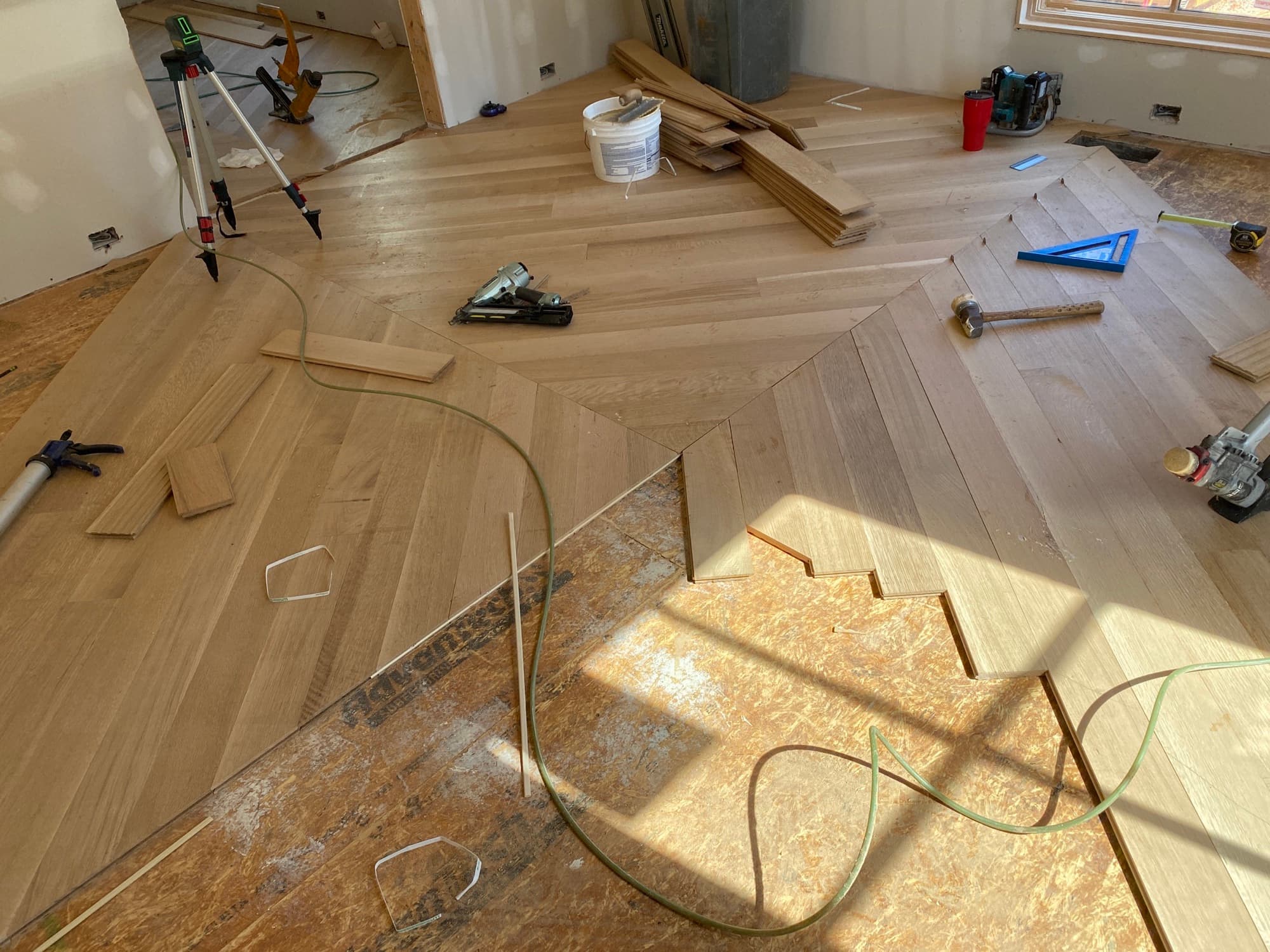
Layout complexity also affects labor cost. Standard straight-run installation in a rectangular room is the most efficient layout. Diagonal layouts, herringbone, or rooms with many angles or obstacles add cutting time. A great room with an open floor plan is typically faster to install per square foot than the same square footage spread across multiple small rooms with doorways, closets, and transitions at every boundary.
What Cheap Installation Actually Costs You
Low-price hardwood installation quotes in the Raleigh market typically involve one or more of the following: skipped moisture testing, no subfloor flatness correction, staple installation instead of cleat nailing, no acclimation of the wood before installation, prefinished material presented as equivalent to site-finished, and single-component finish products that wear faster than commercial-grade systems.
Floors installed over moisture that was not tested or corrected cup, buckle, and gap. Floors installed over a subfloor that was not flattened develop squeaks and movement. Floors installed without proper acclimation gap in dry weather and cup in humid weather. These are not warranty situations. They are the expected result of a job that was not done correctly from the start. The correction cost is always higher than the cost of doing it right the first time.
Questions and Answers
Is site-finished hardwood worth the extra cost over prefinished?
For most homeowners in Raleigh who are planning to stay in the home long-term, yes. Site-finished hardwood is sanded as one continuous surface after installation, which means no bevels between boards that collect dirt and debris. The color and finish system are chosen specifically for your floor and applied fresh on-site. The result looks better, lasts longer, and can be refinished multiple times in the future. Prefinished is faster and less disruptive, but it is a different product with a different long-term outcome.
What species of hardwood is best for high-traffic areas in Raleigh homes?
White oak is the most popular choice in Triangle new construction right now for good reason. It is harder than red oak on the Janka scale, takes stain evenly including gray and neutral tones, and holds up well under daily traffic. Red oak is slightly softer but has been the standard in Triangle homes for decades and performs well. For the hardest domestic option, hickory or hard maple are the top performers, though hickory can be difficult to stain evenly.
What is the difference between nail-down, glue-down, and floating installation?
Nail-down (specifically cleat nailing) is the standard method for solid hardwood over a wood subfloor. It is the most secure fastening method and the one we use exclusively for solid hardwood. Glue-down is used for engineered hardwood over concrete slab, with a structural adhesive bonding the planks directly to the substrate. Floating installation uses click-lock planks that are not fastened to the subfloor. It is appropriate for certain engineered products but is not suitable for solid hardwood.
Does subfloor condition really affect the installation cost?
Yes, and significantly. A flat, dry subfloor ready for installation adds no prep cost. A subfloor with high spots, low spots, moisture issues, or soft areas from water damage requires correction before any flooring is installed. We test every subfloor with two moisture meters (Tramex MEX5 and Delmhorst Total Check) and correct flatness to within 3/16 inch over 10 feet. Skipping these steps causes squeaks, movement, gaps, and finish failure down the road.
What does removal of existing flooring cost?
Removal and disposal of existing flooring is typically scoped and priced as a separate line item. The cost depends on the type of flooring being removed, whether adhesive is involved (old glue-down floors take more labor to remove and prep), and how the subfloor is left behind. We include removal in our written estimates when it is part of the scope so there are no surprises.
Why does wide plank hardwood cost more than strip flooring?
Wide plank material is more expensive per board foot because wider boards require larger, older trees and produce more waste during milling. Wide plank floors also have more wood movement than narrow strip floors, which requires careful acclimation and moisture management before and during installation. The wider the board, the more critical it is to get subfloor moisture and humidity conditions right before installation.
Related Reading
Get Your Number
In-Home Assessment in Raleigh
We measure the space, test the subfloor, discuss species and finish options, and give you a written estimate with no surprises. Izral Daniels handles every assessment personally. Call 984-400-4OAK or request online.
Request Free EstimateWant a real number instead of a range? Request a free estimate. We measure your rooms, talk through species and grade, and send a proposal with every option priced.
These are the numbers we quote from, not a national average. We handle hardwood floor installation across the Triangle, including Raleigh, Wendell, and Fuquay-Varina. Request a free estimate and we will look at your floor in person before we talk numbers.